WWI UNIT ASSIGNMENTS
Worksheets and Power Points can be found at Technical Thompson's Website
1) Table of Contents
2) Entangled Alliances
3) Map of Europe (p.353 & 359)
4) Powderkeg & Dominoes
5) Weapons of WWI
6) War Affects the World
7) Flawed Peace
8) Killing Fields (WWI Video Notes)
9) Propaganda Notes
10 Vocabulary & Study Guide
BBC's Website has some great information on WWI
MONDAY January 12th, 2009
1) SSR WWI Comic Book Review (A Legacy Project by A-Yeung Hyun)
2) Table of Contents (TOC) (Assign #1)
3) Review Entangled Alliances (Assign #2)
4) Review Map & Alliances of Europe (p.353 & 359) (Assign #3)
HW:
a) Complete Assign 1-3
b) Bring book to class (Tues & Rest of the week)
c) Read p.352 - 357
d) Complete Terms for Vocab Section 1: Great War Begins 1-12
c) Prep for Semester Final (Study Final Exam or Work on Legacy Project due the week of January 27th - 29th)
TUESDAY January 13, 2009 Minimum Day - Dismissal 1:21pm
1) Read as class or SSR WWI Comic Book Review (A Legacy Project by A-Yeung Hyun)
2) Start Powderkeg & Dominoes (Assign #4)
HW:
a) Complete Powderkeg & Dominoes (Assign #4)
b) Read Section 2: A New Kind of War p.358-364
c) Complete Vocab Section 2: A New Kind of War #13-27 (Assign #10)
WEDNESDAY January 14, 2009
1) Weapons of WWI (Assign #5) -- HW check Assign #4 while students work on Assign #5
2) Review Powderkeg & Dominoes (Assign #4)
3) Start War Affects the World (Assign #6)
HW:
a) Complete Assignments 1 -6
b) Complete War Affects the World (Assign #6)
c) Complete Vocab Section 3: Winning The War #28 - 40 (Assign #10)
THURSDAY January 15, 2009
1) Start: A Flawed Peace (Assign #7)
2) Review: War Affects the World (Assign #6)
HW:
a) Complete Assignments 1-7
b) Complete A Flawed Peace (Assign #7)
c) Complete Vocab Section 4: Making the Peace (Assign #10)
FRIDAY January 16, 2009
1) WWI Quiz?
1) Killing Fields (WWI) Video Notes - Assign #8 - students must be present to complete video notes.
HW:
A) Two more weekends to work on those Legacy Projects
B) Study for the Final Exam
MONDAY January 19, 2009
1)MLK Jr Holiday - No School
Click here to listen to Mr. P's favorite MLK Jr talk entitled: But If Not
TUESDAY January 20, 2009
1) WWI Lessons of Life
i) Gallipoli
ii) Johnny Got His Gun
3) Final Review of Assign 1-8
HW:
a) Be sure to review & have WWI Assigns 1-8 completed
b) Finals - Work on your legacy project or study for semester final exam.
WEDNESDAY January 17, 2007
1) Recap Gallipoli & Johnny Got His Gun
2) Propaganda (Assign #9)
HW:
a) Be sure to review & have WWI Assigns 1-8 completed
b) Finals - Work on your legacy project or study for semester final exam.
c) Click here for more Multiple Choice Practice Quizzes
THURSDAY January 22, 2009
1) Recap Propaganda
2) Final Review of Assign 1-10
3) Flawed Peace Review
HW:
a) Be sure to review & have WWI Assigns 1-8 completed
b) Finals - Work on your legacy project or study for semester final exam.
FRIDAY January 23, 2009
1) WWI Flawed Peace Discussion (Assign #9)
HW:
a) Final Weekend to work on your Legacy Project or study for the Semester Multiple Choice Exam Final
a) WWI Packets will be due the day of your Semester Final
b) There will NOT be a WWI Exam. Instead WWI questions will appear as portion of the semester final exam. Those students not taking the final exam, but instead are doing a legacy project will turn in their legacy project on the day of the final. Students doing a Legacy Project will only take the WWI portion of the final exam on the day of semester final.
c) Click here for more Multiple Choice Practice Quizzes
MONDAY January 26, 2009
Semester Final Review Game
HW:
A) Last few days to work on those Legacy Projects
TUESDAY January 27, 2009
Semester Finals Period (1 & 2)
HW:
A) Last day to work on those Legacy Projects
WEDNESDAY January 28, 2009
Finals (Period 3 & 4)
THURSDAY January 29, 2009
Finals (Period 5 & 6)
FRIDAY January 30, 2009
Student Free Day
Scroll down get more info on Semester Finals
SEMESTER FINAL INFORMATION
OK People of Pesusich-ville. This is the final stretch to the first semester. The big thing coming up is the semester final. The semester final will count for 20% of your final grade. Be sure to put in appropriate time and effort to assure you do well.
THE SEMESTER FINAL
There are 2 options for the semester final. As previously determined earlier in the semester, you are either going to:
a) take the Multiple Choice Exam
or
b) present and turn in your Legacy Project
FINAL SCHEDULE
1) January 27th Tuesday = Period 1 & 2
2) January 28th Wednesday = Period 3 & 4
3) January 29th Thursday = Period 5 & 6
FINAL PREPARATION
1) Legacy Project - 20% of Semester Grade
A) Students doing a Legacy Project should be working on final touches to their project at this point in the semester if they expect to put a quality project together.
B) Do NOT come and ask Mr. P for help in the closing weeks to the semester. He has been available to help students throughout the semester. He will be busy with his own work after school. He will only be available to quickly examine projects (under 4 minutes) to offer suggestions so students might adjust and improve their projects before the due date.
C) Good luck! Lycka Till! Buena Suerte! May the force be with you! Do your best and be sure to turn in a quality final project that will be a useful tool for future students of world history. Remember: "All things on Earth are soon forgotten except the memory left behind in the minds of men." Be sure to leave your legacy behind at West.
2) Multiple Choice Exam - 20% of Semester Grade
A) Review your unit packets from this semester.
B) Review unit information from the semseter in your textbook.
C) Review and practice online quizzes and info.
a) Autocracy vs Democracy
b) French Revolution
c) Nationalism & Imperialism
iii) Click here for more Multiple Choice Practice Quizzes
iv) Click below on a multitude of online Multiple Choice (MC) practice quizzes to help students prep for the semester final.
WORLD HISTORY SEMESTER FINAL MULTIPLE CHOICE ONLINE REVIEW
RENAISSANCE
http://historyteacher.net/EuroProjects/ExamReviewSheets/MatchingQuizzesForFinalReview-2001/MATCH-Renaissance.htm
http://historyteacher.net/APEuroCourse/EHAP-Quizzes/Renaissance-2.htm
http://historyteacher.net/APEuroCourse/EHAP-Quizzes/Renaissance-1.htm
REFORMATION
http://www.historyteacher.net/EuroProjects/ExamReviewSheets/MatchingQuizzesForFinalReview-2001/MATCH-Reformation.htm
http://historyteacher.net/APEuroCourse/EHAP-Quizzes/Reformations-3.htm
http://historyteacher.net/APEuroCourse/EHAP-Quizzes/Reformations-2.htm
http://historyteacher.net/APEuroCourse/EHAP-Quizzes/Reformations-1.htm
SCIENTIFIC REVOLUTION
http://historyteacher.net/EuroProjects/ExamReviewSheets/MatchingQuizzesForFinalReview-2001/MATCH-ScientificRevolution.htm
http://historyteacher.net/APEuroCourse/EHAP-Quizzes/ScientificRevol-2.htm
http://historyteacher.net/APEuroCourse/EHAP-Quizzes/ScientificRevol-1.htm
ENLIGHTENMENT
http://historyteacher.net/EuroProjects/ExamReviewSheets/MatchingQuizzesForFinalReview-2001/MATCH-Enlightenment.htm
http://historyteacher.net/APEuroCourse/EHAP-Quizzes/Enlightenment-2.htm
http://historyteacher.net/APEuroCourse/EHAP-Quizzes/Enlightenment-1.htm
FRENCH REVOLUTION
http://historyteacher.net/EuroProjects/ExamReviewSheets/MatchingQuizzesForFinalReview-2001/MATCH-FrenchRevolution.htm
http://historyteacher.net/APEuroCourse/EHAP-Quizzes/FrenchRevol-3.htm
http://historyteacher.net/APEuroCourse/EHAP-Quizzes/FrenchRevol-2.htm
http://historyteacher.net/APEuroCourse/EHAP-Quizzes/FrenchRevol-1.htm
NAPOLEON
http://historyteacher.net/APEuroCourse/EHAP-Quizzes/Napoleon-1.htm
http://historyteacher.net/EuroProjects/ExamReviewSheets/MatchingQuizzesForFinalReview-2001/MATCH-NapoleonicEra.htm
http://historyteacher.net/APEuroCourse/EHAP-Quizzes/Napoleon-2.htm
INDUSTRIAL REVOLUTION
http://historyteacher.net/APEuroCourse/EHAP-Quizzes/IndustrialRevolution-1.htm
http://historyteacher.net/APEuroCourse/EHAP-Quizzes/IndustrialRevolution-2.htm
http://historyteacher.net/EuroProjects/ExamReviewSheets/MatchingQuizzesForFinalReview-2001/MATCH-IndustrialRevolution.htm
NATIONALISM
http://historyteacher.net/APEuroCourse/EHAP-Quizzes/19cNationalism-1.htm
http://historyteacher.net/APEuroCourse/EHAP-Quizzes/19cNationalism-2.htm
IMPERIALISM
http://historyteacher.net/EuroProjects/ExamReviewSheets/MatchingQuizzesForFinalReview-2001/MATCH-NewImperialism.htm
http://historyteacher.net/APEuroCourse/EHAP-Quizzes/NewImperialism-1.htm
WWI
http://historyteacher.net/APEuroCourse/EHAP-Quizzes/WorldWarI-1.htm
http://historyteacher.net/APEuroCourse/EHAP-Quizzes/WorldWarI-2.htm
http://historyteacher.net/EuroProjects/ExamReviewSheets/MatchingQuizzesForFinalReview-2001/MATCH-WW1.htm
2) Legacy Project - 20% of Semester Grade
1) Students doing a Legacy Project should be working on final touches to their project at this point in the semester if they expect to put a quality project together.
2) Do NOT come and ask Mr. P for help in the closing weeks to the semester. He has been available to help students throughout the semester. He will be busy with his own work after school. He will only be available to quickly examine projects (under 4 minutes) to offer suggestions so students might adjust and improve their projects before the due date.
3) Good luck! Lycka Till! Buena Suerte! May the force be with you! Do your best and be sure to turn in a quality final project that will be a useful tool for future students of world history. Remember: "All things on Earth are soon forgotten except the memory left behind in the minds of men." Be sure to leave your legacy behind at West.
1/2 of your experience of P-Ville will soon be behind you.
Monday, December 15, 2008
NATIONALISM & IMPERIALISM PACKET & WORKSHEETS
Refer to Technical Thompson's Website to print out worksheets
1) Table of Contents
2) KWL
3) Vocabulary
4) Bonds that create a Nation State
5) Proclamation of 1860
6) Nationalist Speech
7) Languages Fuel Nationalism FRONT(Map) & BACK (Questions)
8) Nationalism & Disunity
9) Cause & Effect
10) Franco-Prussian War (p.231 & p. 269 – 271) & Crimean War
11) Imperialism 5 W’s
12) Map of Africa
13) QW Imperial Cartoons
14) British Contact with African King / Letter from Menelik II
15) Analyzing Imperial Motives (Front side & Back side)
16) Imperial World Map
***PLEASE NOTE: MR P MIGHT MAKE THE WORKSHEET BELOW AN ASSIGNMENT***
Assign # ? = Analyzing Assumptions and Biases
MONDAY December 15, 2008
1) IR Packet due before tardy bell
2) IR Exam
3) “P” is for “P”atron Art Vote
4) Post Test Survey
HW:
A) Go to Mr. P website copy down TOC (Assign #1) for next unit: Nationalism
B) Print out worksheets (assigns 4-7) from Technical Thompson’s website for next unit: Nationalism.
C) Do KWL for Nationalism Unit (Assign #2)
D) Come to class ready discuss, think and question the topic of Nationalism
TUESDAY December 16, 2008
1) IR Exam Results
2) TOC (Assign #1)
3) KWL (Assign #2)
4) Vocab (Assign #3)
5) Bonds that create a Nation State (Assign #4)
6) Proclamation of 1860 (Assign #5)
7) Nationalist Speech (Assign #6)
8) Languages Fuel Nationalism (Assign #7)
HW:
A) Work on Vocab (Assign #3)
B) Complete Assignments 5 & 6
C) Assignments 1-7 Covered in class
WEDNESDAY December 17, 2008
1) HW Review / Quiz?: Proclamation of 1860 (Assign #5)
2) HW Review / Quiz?: Nationalist Speech (Assign #6)
3) Languages Fuel Nationalism (Assign #7)
4) Nationalism & Disunity (Assign #8)
5) Cause & Effect (Assign #9)
6) Recap Nationalism
7) Crimean War (Who, What, When, Where and Why) – p. 244, 247, 255 (Assign #10)
8) Franco Prussian War (p.231 & 269 – 271) (Assign #10)
HW:
a) Complete Assign #1-9
b) Assign 2 = KWL - Students should continually add to the LEARNED portion of the assignment throughout the unit.
c) Assign 3 = Vocab - Students are expected to continually work on and complete all vocab words by the end of the unit. Most vocab words will be defined in class more than once. However, students will be expected to define and know all words on the Vocab list, whether some of the words are defined in class or not.
d) Read and understand: Crimean War (p. 244, 247, 255 - use Index in textbook if this page is wrong)
THURSDAY December 18, 2008
1) Nationalism & Disunity (Assign #8)
2) Cause & Effect (Assign #9)
3) Recap Nationalism
4) Crimean War (Who, What, When, Where and Why)
5) Review 5 W's of Imperialism (Assign #11)
6) Map of Africa (Assign #12) / African Border Dilemma
7) Interpreting Imperial Political Cartoons (Assign #13)
HW:
A) Franco-Prussian War p.2 (Assign #10)
B) READ & COMPLETE QUESTIONS: Letter from Menenik II/ British Contact with African King (Assign #14)
C) COLOR & IDENTIFY: Imperial World Map (Assign #16)
D) Possible HW Quiz on Monday: i) Imperial World Map ii) Vocab
E) Have appropriate worksheets printed out and supplies for Monday brought to class
F) Complete Assign #1-16
FRIDAY December 19, 2008
1) TBA
HW:
A) Nationalism & Imperialism Exam will be the Friday upon return from Winter Break
B) Legacy Projects will be due at the end of the semester. Winter Break should be used to make great strides on working to complete your project.
IT IS A NEW YEAR! WHAT THE HECK!
Refer to Technical Thompson's Website to print out worksheets
MONDAY January 5, 2009
1) What? It is 2009 now? How did that happen? How was the break?
2) Looking at the Final Stretch (Semester Finals Start = January 27th)
3) Recap Nationalism
4) Crimean War (Who, What, When, Where and Why)
5) Review 5 W's of Imperialism (Assign #11)
6) Imperial World Maps (Assign #16)
7) Map of Africa (Assign #12) / African Border Dilemma
8) Interpreting Imperial Political Cartoons (Assign #13)
HW:
1) MAIN WORK FOR TONIGHT
A) Complete Assign 1-12
B) Work on Vocab (Assign #3) - Due Friday
C) Map of Africa (Assign #12) - Print out from Kana's website, read Ch 9 Section 2, complete for Tuesday
2) PRINT OUT, BRING TO CLASS TUESDAY & DUE FRIDAY
D) Print out Assign 12, 14-16 from Kana's Website or have someone print out for you
E) Letter from Menenik II/ British Contact with African King (Assign #14)
F) Analyzing Imperial Motives (Front & Back) (Assign #15)
G) COLOR & IDENTIFY: Imperial World Map (Assign #16)
3) BRING BOOK TO CLASS THIS WEEK!
4) ASSIGNMENTS 1-16 DUE FRIDAY
5) EXAM ON FRIDAY
TUESDAY January 6, 2009
1) SSR Letter from Menenik II / British Contact with African King (Assign #14)
2) Review Map of Africa (Assign #12)
3) Imperial World Maps (Assign #16)
HW:
A) Assign 1-14 covered in class
B) Completing 1-14
C) Continuing Vocab (Assign #14)
D) Work on Imperial World Map (Assign #16)
E) Possible HW Quiz on Tuesday: i) Imperial World Map ii) Vocab
WEDNESDAY January 7, 2009
1) HW Quiz based on Imperial World Map (Assign #16) & Vocab (Assign #3) BE READY!
2) Analyzing Imperial Motives (Assign #15)
3) Imperial Cartoons (Assign #13)
4) Analyzing Assumptions and Bias (If time permits)
HW:
A) Assignments 1-16 covered in class
B) Students should be finalizing completion of Assign 1-16
C) Study Assign 1-16 for Exam on Friday
THURSDAY January 8, 2009
1) Review of any assignments (1-16) not covered thus far
2) Review Game for Exam (Friday)
HW:
A) Assignments 1-16 completed, stapled and ready to turn in tomorrow
B) Study Assignments 1-16 for Exam
FRIDAY January 9, 2009
1) Assignment 1-16 Stapled Packet DUE Friday before the tardy bell
2) Nationalism & Imperialism Exam
3) Begin WWI
HW:
A) TBA
B) Work on them Legacy projects!
C) Start studying for the final exam!
Finals
Tuesday, January 27th = Period 2
Wednesday,January 28th = Period 3 & 4
Thursday, January 29th = Period 5 & 6
Alan Parson's Project - Eye in the Sky
Alan Parson's Project - Eye Robot
Refer to Technical Thompson's Website to print out worksheets
1) Table of Contents
2) KWL
3) Vocabulary
4) Bonds that create a Nation State
5) Proclamation of 1860
6) Nationalist Speech
7) Languages Fuel Nationalism FRONT(Map) & BACK (Questions)
8) Nationalism & Disunity
9) Cause & Effect
10) Franco-Prussian War (p.231 & p. 269 – 271) & Crimean War
11) Imperialism 5 W’s
12) Map of Africa
13) QW Imperial Cartoons
14) British Contact with African King / Letter from Menelik II
15) Analyzing Imperial Motives (Front side & Back side)
16) Imperial World Map
***PLEASE NOTE: MR P MIGHT MAKE THE WORKSHEET BELOW AN ASSIGNMENT***
Assign # ? = Analyzing Assumptions and Biases
MONDAY December 15, 2008
1) IR Packet due before tardy bell
2) IR Exam
3) “P” is for “P”atron Art Vote
4) Post Test Survey
HW:
A) Go to Mr. P website copy down TOC (Assign #1) for next unit: Nationalism
B) Print out worksheets (assigns 4-7) from Technical Thompson’s website for next unit: Nationalism.
C) Do KWL for Nationalism Unit (Assign #2)
D) Come to class ready discuss, think and question the topic of Nationalism
TUESDAY December 16, 2008
1) IR Exam Results
2) TOC (Assign #1)
3) KWL (Assign #2)
4) Vocab (Assign #3)
5) Bonds that create a Nation State (Assign #4)
6) Proclamation of 1860 (Assign #5)
7) Nationalist Speech (Assign #6)
8) Languages Fuel Nationalism (Assign #7)
HW:
A) Work on Vocab (Assign #3)
B) Complete Assignments 5 & 6
C) Assignments 1-7 Covered in class
WEDNESDAY December 17, 2008
1) HW Review / Quiz?: Proclamation of 1860 (Assign #5)
2) HW Review / Quiz?: Nationalist Speech (Assign #6)
3) Languages Fuel Nationalism (Assign #7)
4) Nationalism & Disunity (Assign #8)
5) Cause & Effect (Assign #9)
6) Recap Nationalism
7) Crimean War (Who, What, When, Where and Why) – p. 244, 247, 255 (Assign #10)
8) Franco Prussian War (p.231 & 269 – 271) (Assign #10)
HW:
a) Complete Assign #1-9
b) Assign 2 = KWL - Students should continually add to the LEARNED portion of the assignment throughout the unit.
c) Assign 3 = Vocab - Students are expected to continually work on and complete all vocab words by the end of the unit. Most vocab words will be defined in class more than once. However, students will be expected to define and know all words on the Vocab list, whether some of the words are defined in class or not.
d) Read and understand: Crimean War (p. 244, 247, 255 - use Index in textbook if this page is wrong)
THURSDAY December 18, 2008
1) Nationalism & Disunity (Assign #8)
2) Cause & Effect (Assign #9)
3) Recap Nationalism
4) Crimean War (Who, What, When, Where and Why)
5) Review 5 W's of Imperialism (Assign #11)
6) Map of Africa (Assign #12) / African Border Dilemma
7) Interpreting Imperial Political Cartoons (Assign #13)
HW:
A) Franco-Prussian War p.2 (Assign #10)
B) READ & COMPLETE QUESTIONS: Letter from Menenik II/ British Contact with African King (Assign #14)
C) COLOR & IDENTIFY: Imperial World Map (Assign #16)
D) Possible HW Quiz on Monday: i) Imperial World Map ii) Vocab
E) Have appropriate worksheets printed out and supplies for Monday brought to class
F) Complete Assign #1-16
FRIDAY December 19, 2008
1) TBA
HW:
A) Nationalism & Imperialism Exam will be the Friday upon return from Winter Break
B) Legacy Projects will be due at the end of the semester. Winter Break should be used to make great strides on working to complete your project.
IT IS A NEW YEAR! WHAT THE HECK!
Refer to Technical Thompson's Website to print out worksheets
MONDAY January 5, 2009
1) What? It is 2009 now? How did that happen? How was the break?
2) Looking at the Final Stretch (Semester Finals Start = January 27th)
3) Recap Nationalism
4) Crimean War (Who, What, When, Where and Why)
5) Review 5 W's of Imperialism (Assign #11)
6) Imperial World Maps (Assign #16)
7) Map of Africa (Assign #12) / African Border Dilemma
8) Interpreting Imperial Political Cartoons (Assign #13)
HW:
1) MAIN WORK FOR TONIGHT
A) Complete Assign 1-12
B) Work on Vocab (Assign #3) - Due Friday
C) Map of Africa (Assign #12) - Print out from Kana's website, read Ch 9 Section 2, complete for Tuesday
2) PRINT OUT, BRING TO CLASS TUESDAY & DUE FRIDAY
D) Print out Assign 12, 14-16 from Kana's Website or have someone print out for you
E) Letter from Menenik II/ British Contact with African King (Assign #14)
F) Analyzing Imperial Motives (Front & Back) (Assign #15)
G) COLOR & IDENTIFY: Imperial World Map (Assign #16)
3) BRING BOOK TO CLASS THIS WEEK!
4) ASSIGNMENTS 1-16 DUE FRIDAY
5) EXAM ON FRIDAY
TUESDAY January 6, 2009
1) SSR Letter from Menenik II / British Contact with African King (Assign #14)
2) Review Map of Africa (Assign #12)
3) Imperial World Maps (Assign #16)
HW:
A) Assign 1-14 covered in class
B) Completing 1-14
C) Continuing Vocab (Assign #14)
D) Work on Imperial World Map (Assign #16)
E) Possible HW Quiz on Tuesday: i) Imperial World Map ii) Vocab
WEDNESDAY January 7, 2009
1) HW Quiz based on Imperial World Map (Assign #16) & Vocab (Assign #3) BE READY!
2) Analyzing Imperial Motives (Assign #15)
3) Imperial Cartoons (Assign #13)
4) Analyzing Assumptions and Bias (If time permits)
HW:
A) Assignments 1-16 covered in class
B) Students should be finalizing completion of Assign 1-16
C) Study Assign 1-16 for Exam on Friday
THURSDAY January 8, 2009
1) Review of any assignments (1-16) not covered thus far
2) Review Game for Exam (Friday)
HW:
A) Assignments 1-16 completed, stapled and ready to turn in tomorrow
B) Study Assignments 1-16 for Exam
FRIDAY January 9, 2009
1) Assignment 1-16 Stapled Packet DUE Friday before the tardy bell
2) Nationalism & Imperialism Exam
3) Begin WWI
HW:
A) TBA
B) Work on them Legacy projects!
C) Start studying for the final exam!
Finals
Tuesday, January 27th = Period 2
Wednesday,January 28th = Period 3 & 4
Thursday, January 29th = Period 5 & 6
Alan Parson's Project - Eye in the Sky
Alan Parson's Project - Eye Robot

Monday, December 01, 2008
INDUSTRIAL REVOLUTION ASSIGNMENTS
1) TOC
2) KWL (at end of unit write what meaningful stuff you learned – 1 page)
3) Study Guide (Vocab Words)- Crop Rotation
4) Crossword Puzzle
5) IR Video Notes
6) Chapter 5 & 6 Guided Reading Notes
Chapter 5 p.170-189
Section 1 Dawn of the Industrial Age p.170 -173
Section 2 Britain Leads the Way p.174-177
Section 3 Social Impact of IR p.178-183
Section 4 New Ways of Thinking p.184-189
Chapter 6 p.195-221
Section 1 IR Spreads p.196-202
Section 2 Rise of the Cities p.203-209
Section 3 Changing Attitudes & Values p.210-216
Section 4 Arts in the Industrial Age p.217-221
7) Economic Process
8) Economic Spectrum
9) Economic Choice
10) Impact of the IR
11) Workers & Owners
12) Unions Pros & Cons
13) Sueta Plan
14) Distribution of Wealth
15) Story of Stuff Video Notes
MONDAY December 1, 2008
1) TOC
2) KWL
3) Study Guide (Vocab Words)
4) Crossword Puzzle
5) IR Video Notes
6) Guided Reading Notes
a. Chapter 5 Sections 1 & 2
HW:
a) Bring covered textbook to class everyday
b) Ch 5 Section 1 & 2 Guided Reading Notes
c) Study for Quick Quiz on Section 1 & 2 (Tuesday)
TUESDAY December 2, 2008
1) Quick Quiz – Ch 5 Sections 1 & 2 - Students can use HW (Assign 6)
2) Collect HW (Assign #6)
3) Economic Process (Assign 7)
4) Economic Cartoon
5) Capitalism & Marxism Scenarios
HW:
a) Bring covered textbook to class everyday
b) Ch 5 Section 3 & 4 Guided Reading Notes
c) Study for Quick Quiz on Section 3 & 4 (Wednesday)
d) Assign 1-7 covered in class
WEDNESDAY December 3, 2008
1) Quick Quiz – Ch 5 Sections 3 & 4
2) Collect HW (Assign #6)
3) Capitalism & Marxism Scenarios
4) Economic Spectrum (Assign 8)
5) Economic Choice (Assign 9)
HW:
a) Bring covered textbook to class everyday
b) Ch 5 Section 4 Guided Reading Notes
c) Study for Quick Quiz on Section 4 (Thursday)
d) Assign 1-9 covered in class
THURSDAY December 4, 2008
1) Quick Quiz – Ch 5 Section 4
2) Impact of the IR (Assign 10)
3) Workers & Owners (Assign 11)
4) Economic Choice Discussion (Assign 9)
HW:
a) Complete Impact of IR (Assign #10)
b) Bring covered textbook to class everyday
c) Ch 6 Section 1 & 2 Guided Reading Notes
d) Study for Quick Quiz on Section 1 (Friday)
e) Assign 1-10 covered in class
Need to finish Assign 10?
EFFECTS OF INDUSTRIAL REVOLUTION (Assign #10)
Impact of the Industrial Revolution Front Page & Back Page
a) Working Conditions & Wages
b) Child Labor
c) Changing role of Women
d) Conditions in the Coal Mines
e) Urbanization
f) Education
g) Changing class structure
h) Industrial Production
i) Modern Buildings
j) Modern Inventions
FRIDAY December 5, 2008
1) Workers & Owners (Assign 11)
2) Union Pros & Cons (Assign 12)
HW:
a) Complete Assignments 1-11
b) Complete Ch 6 Section 3 & 4 Guided Reading Notes
MONDAY December 8, 2008
1) Unions Pros & Cons (Assign 12)
2) Sueta Plan (Assign 13)
HW:
a) Complete Assignments 1-13
b) Work on Distribution of Wealth (Assign 14)
TUESDAY December 9, 2008
1) Post Sueta Plan Discussion (Assign 13)
2) Discuss Distribution of Wealth (Assign 14)
3) 100 pennies
4) Man out on Hawthorne
WEDNESDAY December 10, 2008
1) Discuss Budget
HW:
1) Complete, Organize and Staple Assignment 1-15
2) Study for IR Exam Friday
THURSDAY December 11, 2008
1) IR Review
HW:
1) Organize and Staple Packet at home
2) Study for Exam
FRIDAY December 12, 2008
1) Industrial Revolution Packet Due (Assign 1-14)
2) Industrial Revolution Exam
3) Post Test Survey
4) Start Nationalism & Imperialism Unit
HW: None
RANDOM INTERNATIONAL TRADITIONAL NEWS FROM PNN
So to prepare for the Holiday Season and being that this is the World History section of the Website, you all have to check this one out. Apparently, the Swedes have this wacky Christmas tradition of making a giant goat from like a hay material after the harvest season. The Swedish city of Gavle claims to make the biggest giant goat in the world. It is suppose to be a traditional symbol of Christmas in Sweden. The funny thing about the giant goat is that it is suppose to be up through Christmas and the New Year but each year the giant goat usually does NOT makes it. Each year some phantom Swede (or others like even a 51 yr old American in 2001) comes along and lights the giant goat on fire. Each year security is stepped up and each year the burning of the giant goat gets more elaborate. Supposedly, it is big news in Sweden. The smirking newsman will come on TV and say something like, “Well, the giant goat got it early this year” or “Although it lasted longer than usual, the giant horse has suffered the same fate once again.” I hear that most Swedes laugh about the whole thing. Yet, the security tries to take it serious by preventing a burning and have the giant goat make it to Christmas. This year security has two 24 hour web-cam monitoring things. Also, there is apparently some nonflammable substance to protect the giant goat from any possible attempts to burn it down. Will the security protect the giant goat until Christmas or will the same wacky burning tradition continue? Be sure to monitor this goofy international story during the holiday season. Lycka Till, Giant Goat!
Here is the link to the webcam of the Crazy Swedish Christmas Goat that burns almost every year
Teachers work hard
Teachers get paid to make people think
Teaching is a difficult but rewarding thing to do
Teaching will keep you up to 3am
1) TOC
2) KWL (at end of unit write what meaningful stuff you learned – 1 page)
3) Study Guide (Vocab Words)- Crop Rotation
4) Crossword Puzzle
5) IR Video Notes
6) Chapter 5 & 6 Guided Reading Notes
Chapter 5 p.170-189
Section 1 Dawn of the Industrial Age p.170 -173
Section 2 Britain Leads the Way p.174-177
Section 3 Social Impact of IR p.178-183
Section 4 New Ways of Thinking p.184-189
Chapter 6 p.195-221
Section 1 IR Spreads p.196-202
Section 2 Rise of the Cities p.203-209
Section 3 Changing Attitudes & Values p.210-216
Section 4 Arts in the Industrial Age p.217-221
7) Economic Process
8) Economic Spectrum
9) Economic Choice
10) Impact of the IR
11) Workers & Owners
12) Unions Pros & Cons
13) Sueta Plan
14) Distribution of Wealth
15) Story of Stuff Video Notes
MONDAY December 1, 2008
1) TOC
2) KWL
3) Study Guide (Vocab Words)
4) Crossword Puzzle
5) IR Video Notes
6) Guided Reading Notes
a. Chapter 5 Sections 1 & 2
HW:
a) Bring covered textbook to class everyday
b) Ch 5 Section 1 & 2 Guided Reading Notes
c) Study for Quick Quiz on Section 1 & 2 (Tuesday)
TUESDAY December 2, 2008
1) Quick Quiz – Ch 5 Sections 1 & 2 - Students can use HW (Assign 6)
2) Collect HW (Assign #6)
3) Economic Process (Assign 7)
4) Economic Cartoon
5) Capitalism & Marxism Scenarios
HW:
a) Bring covered textbook to class everyday
b) Ch 5 Section 3 & 4 Guided Reading Notes
c) Study for Quick Quiz on Section 3 & 4 (Wednesday)
d) Assign 1-7 covered in class
WEDNESDAY December 3, 2008
1) Quick Quiz – Ch 5 Sections 3 & 4
2) Collect HW (Assign #6)
3) Capitalism & Marxism Scenarios
4) Economic Spectrum (Assign 8)
5) Economic Choice (Assign 9)
HW:
a) Bring covered textbook to class everyday
b) Ch 5 Section 4 Guided Reading Notes
c) Study for Quick Quiz on Section 4 (Thursday)
d) Assign 1-9 covered in class
THURSDAY December 4, 2008
1) Quick Quiz – Ch 5 Section 4
2) Impact of the IR (Assign 10)
3) Workers & Owners (Assign 11)
4) Economic Choice Discussion (Assign 9)
HW:
a) Complete Impact of IR (Assign #10)
b) Bring covered textbook to class everyday
c) Ch 6 Section 1 & 2 Guided Reading Notes
d) Study for Quick Quiz on Section 1 (Friday)
e) Assign 1-10 covered in class
Need to finish Assign 10?
EFFECTS OF INDUSTRIAL REVOLUTION (Assign #10)
Impact of the Industrial Revolution Front Page & Back Page

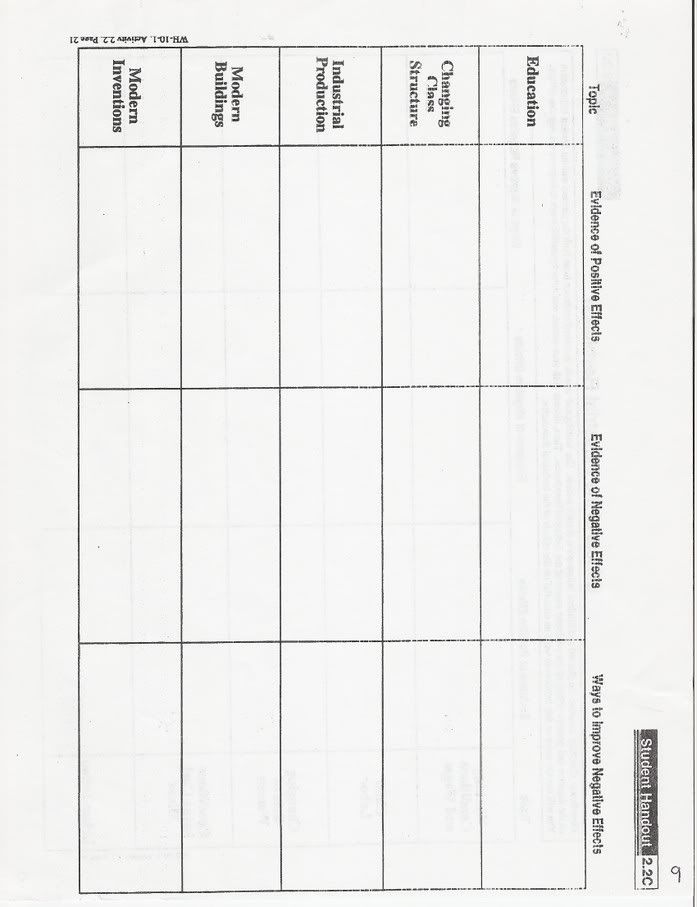
a) Working Conditions & Wages
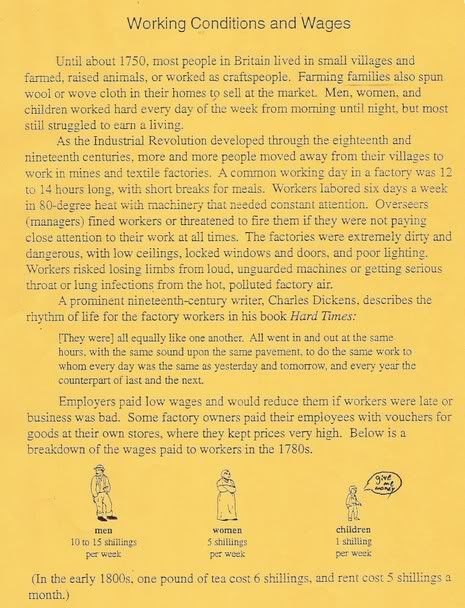
b) Child Labor
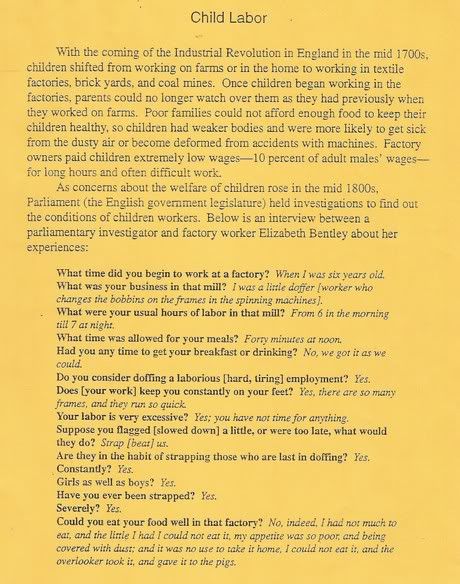
c) Changing role of Women
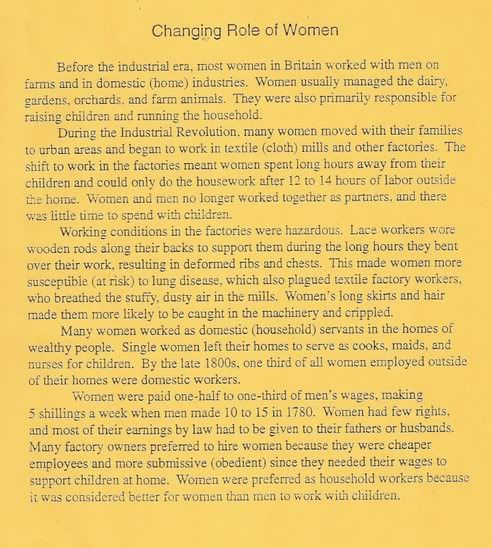
d) Conditions in the Coal Mines
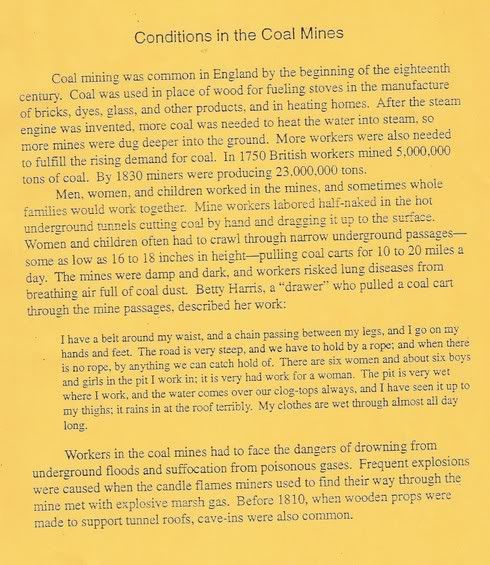
e) Urbanization
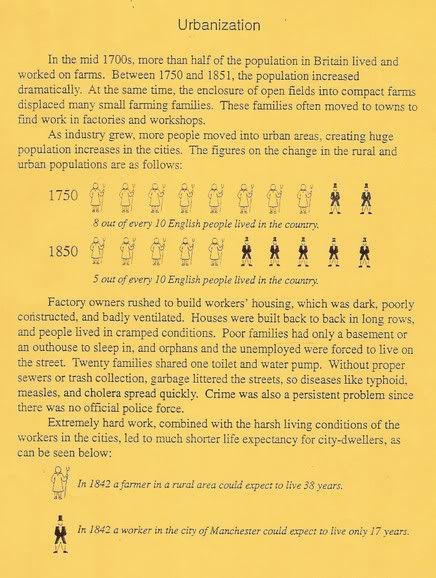
f) Education
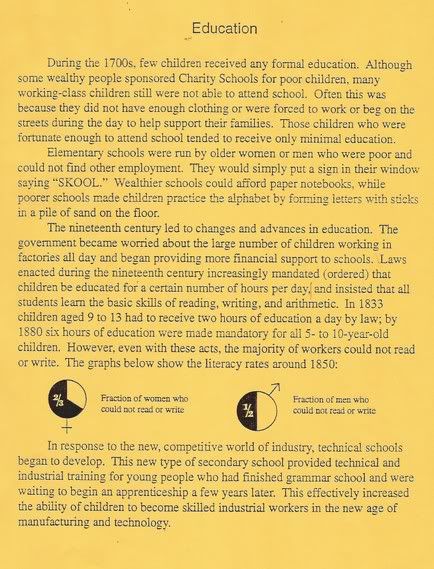
g) Changing class structure
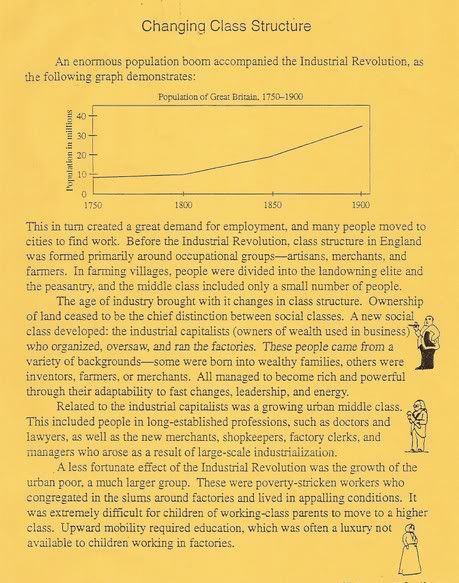
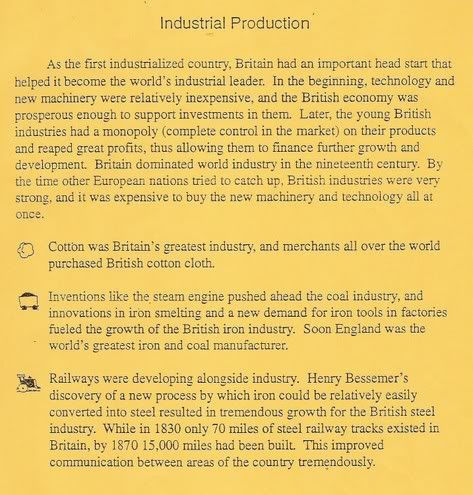
h) Industrial Production
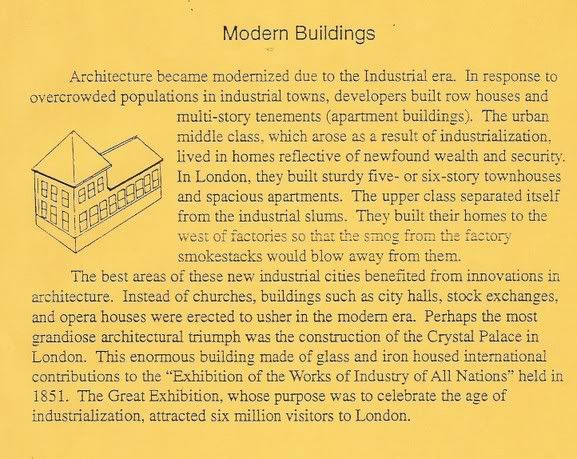
i) Modern Buildings
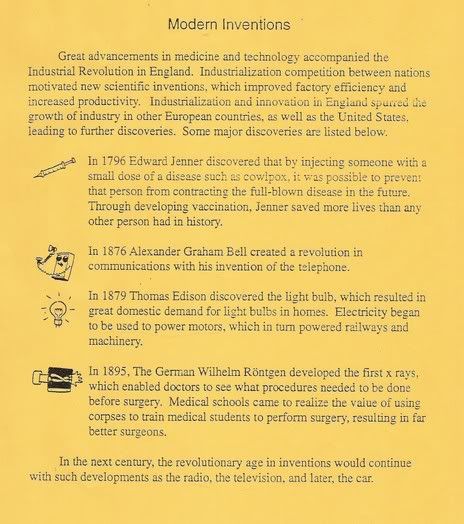
j) Modern Inventions
FRIDAY December 5, 2008
1) Workers & Owners (Assign 11)
2) Union Pros & Cons (Assign 12)
HW:
a) Complete Assignments 1-11
b) Complete Ch 6 Section 3 & 4 Guided Reading Notes
MONDAY December 8, 2008
1) Unions Pros & Cons (Assign 12)
2) Sueta Plan (Assign 13)
HW:
a) Complete Assignments 1-13
b) Work on Distribution of Wealth (Assign 14)
TUESDAY December 9, 2008
1) Post Sueta Plan Discussion (Assign 13)
2) Discuss Distribution of Wealth (Assign 14)
3) 100 pennies
4) Man out on Hawthorne
WEDNESDAY December 10, 2008
1) Discuss Budget
HW:
1) Complete, Organize and Staple Assignment 1-15
2) Study for IR Exam Friday
THURSDAY December 11, 2008
1) IR Review
HW:
1) Organize and Staple Packet at home
2) Study for Exam
FRIDAY December 12, 2008
1) Industrial Revolution Packet Due (Assign 1-14)
2) Industrial Revolution Exam
3) Post Test Survey
4) Start Nationalism & Imperialism Unit
HW: None
RANDOM INTERNATIONAL TRADITIONAL NEWS FROM PNN
So to prepare for the Holiday Season and being that this is the World History section of the Website, you all have to check this one out. Apparently, the Swedes have this wacky Christmas tradition of making a giant goat from like a hay material after the harvest season. The Swedish city of Gavle claims to make the biggest giant goat in the world. It is suppose to be a traditional symbol of Christmas in Sweden. The funny thing about the giant goat is that it is suppose to be up through Christmas and the New Year but each year the giant goat usually does NOT makes it. Each year some phantom Swede (or others like even a 51 yr old American in 2001) comes along and lights the giant goat on fire. Each year security is stepped up and each year the burning of the giant goat gets more elaborate. Supposedly, it is big news in Sweden. The smirking newsman will come on TV and say something like, “Well, the giant goat got it early this year” or “Although it lasted longer than usual, the giant horse has suffered the same fate once again.” I hear that most Swedes laugh about the whole thing. Yet, the security tries to take it serious by preventing a burning and have the giant goat make it to Christmas. This year security has two 24 hour web-cam monitoring things. Also, there is apparently some nonflammable substance to protect the giant goat from any possible attempts to burn it down. Will the security protect the giant goat until Christmas or will the same wacky burning tradition continue? Be sure to monitor this goofy international story during the holiday season. Lycka Till, Giant Goat!
Here is the link to the webcam of the Crazy Swedish Christmas Goat that burns almost every year
Teachers work hard
Teachers get paid to make people think
Teaching is a difficult but rewarding thing to do
Teaching will keep you up to 3am
Sunday, November 02, 2008
FRENCH REVOLUTION ASSIGNMENTS
1) Table of Contents
2) K.W.L.(have at least 22 points listed under L portion for full credit)
3) Vocabulary(p.107-126)
4) Pie Chart (p.108-110)
5) Revolution Threatens the French King (p.108-114)
6) Marie Antionette (ask Mr P for a copy if you cannot read the worksheet online. Also, answer the questions on your own sheet of paper.)
7) Marie Antoinette Video Notes
8) The Execution of Louis XVI (ask Mr P for a copy if you cannot read the worksheet online. Also, answer the questions on your own sheet of paper.)
9) Guided Notes
10) 6 Stages Chart &
FRENCH REVOLUTION POWER POINTS
Use Technical Thompson's Website and scroll down to the unit on French Revolution for help with Assignments 1-10.
Sketch's Website has French Revolution Vocab help. Thanks Sketch! Gee, thanks for making class for students that much more simple. Students should use Sketch's Vocab help but write down definitions using their own West High vernacular. Mr. P will NOT give students credit if they copy Sketch's definitions word for word. Also, Sketch was known for pulling off clever tricks like giving the wrong definition at times to make sure students are thinking and NOT just copying definitions. It is best to check Sketch's definitions against other sources.
C & C French Revolution Vocab help. Same rules mentioned above for Sketch's website applies here.
For students seeking additional reading on the French Revolution, Mr P's Random French Revolution Book Picks for Students are:
a) French Revolution for Beginners by Martin McCrory & Robert Moulder
b) A Short History of the French Revolution by Jeremy Popkin
c) The French Revolution & Napoleonic Era by Owen Connelly
MONDAY November 3, 2008
1) Post Halloween
2) MC Exam Results
3) School Year Thus Far
4) P-Ville Talk
a) Order & Stability Check
b) Daily Announcements
c) Glorious Race
d) Weekly Meetings
5) Start French Revolution
a) TOC
b) K.W.L.
c) Pie Chart
d) 6 Stages of FR
e) Vocabulary
HW:
a) Read p.107-113
b) Start Vocabulary (Assign #3) - Vocab help above
c) Complete Pie Chart (Assign #4)
d) Revolution Threatens the King (Assign #5)
Need help studying for the Geo Retake? Use Sketch's Geo Review. Let Mr P know if it is helpful so he could email Sketch.
TUESDAY November 4, 2008
1) Pie Chart (Assign #4) - Review
2) 6 Stages of French Revolution (Assign #10) - Review
3) Revolution Threatens the King (Assign #5) - Review
HW:
a) Read Section 2 & 3 from Textbook p. 114 - 125
b) Guided Reading Notes for Section 2 & 3 (Assign #9)
b) Complete Vocab (Assign #3) & Study for Vocab Game
c) Marie Antoinette (Assign #6) Read and Answer Questions
d) King Louis' Execution (Assign #8) Read and Answer Questions
Need help studying for the Geo Retake? Use Sketch's Geo Review. Let Mr P know if it is helpful so he could email Sketch.
WEDNESDAY November 5, 2008
1) Order & Stability or SSR for Assign 6-8
2) 6 Stages of French Revolution (Assign #10)- Review
3) Guided Notes (Assign #9) - Review
4) Political Spectrum (Assign #9) - Review
5) Short Video on Marie Antoinette (If time permits. Otherwise, omit assignment #7)
HW
a) Organize & STAPLE French Revolution Packet (Assign 1-10)
b) Study for French Revolution Mini - Exam
Suggestions for Studying:
1) Review Vocab (Assign #3) - Use Sketch's French Revolution Vocab Review and C & C French Revolution Vocab help.
2) Review Pie Chart (Assign #4)
3) Review Revolution Threatens King (Assign #5)
4) Review Guided Notes (Assign #9)
5) Review 6 Stages (Assign #10)
6) Take P Alumni Peymaneh's Quizzes on the French Revolution. Peymaneh's created these quizzes based reading from the old World History textbook. Still, the questions are generally useful for any quiz on the French Revolution. Peymaneh created this legacy project only after living in the US for 8 months. Some of her quiz questions do contain grammar and spelling errors. Mr. P did NOT correct them on purpose. He wanted to also showcase this legacy project to demonstrate what a student can produce despite facing academic setbacks (i.e. Learning a new language and adapting to a new culture). Are you a student facing your own academic setbacks? Mr P challenges you to step it up like Paymaneh, overcome academic set backs and create a legacy project that can be used by students in the future!
NOTICE: Geo Retake will be offered once again at 3:22pm. This will be the 6th offering of the Geo Retake. Come by, ace the Geo Retake and have your original Geo Exam score changed to a perfect score of 40/40. Wow! What an offer! Don't pass up it up, especially if your grade in class is low.
c) Need help studying for the Geo Retake?
Use Sketch's Geo Review. Let Mr P know if it is helpful so he could email Sketch. Not only is she a cool P Alumni but also a Geo Hall of Famer. Other cool stats about Sketch. She is about to graduate from college with a degree in English. Aside from being a college student, she works at Disneyland. She's traveled to Europe a few times. Mr. P and other teachers like Mrs Cerda will always positively remember Sketch as a silent-but-deadly student. She was one who was generally quiet, smart, did high quality work, cared about learning and obviously was a deep thinker. How will Mr P and other teachers remember you? Will they remember you at all?
THURSDAY November 6, 2008
1) Order & Stability Check
2) Vocab Game
3) Simple Quiz
4) MC French Revolution Review Quiz
HW
a) Study for French Revolution Mini-Exam
b) Organize & STAPLE French Revolution Packet (Assign 1-10)
FRIDAY November 7, 2008
1) Turn in French Revolution Packet (Assign 1-10) before tardy bell
2) Review Simple Quiz
3) French Revolution Mini-Exam
4) Start Napoleon (Day 1)
HW
a) Read The Age of Napoleon p. 128-136
b) Legacy Project approval deadline is Friday, November 14th
c) Semester Final is either the Final Exam or a Legacy Project. All students wishing to do a Legacy Project must get approval from Mr. P prior to November 15th.
d) All students not doing a Legacy Project will take a semester Final Exam. The Final Exam is multiple choice. Questions for the multiple choice exam will be cumulative. Thus, any content covered during the first semester can appear on the Semester Final Exam.
e) The Semester Final will be at the end of January. Students taking the Final Exam will take it at the end of January. Students doing a legacy project will turn it in the day the students (not doing a legacy project) take the Semester Final Exam.
SEMESTER FINAL
LEGACY PROJECT OR FINAL EXAM
Each semester students will have a choice of taking either the Final Exam or doing a Legacy Project as their ‘semester’ final. The semester final (exam or project) will equate to 20% - 25 % of the student’s semester grade. There is an application and qualification process that involves doing a legacy project. All students who do not apply or qualify to do a Legacy Project will partake in Final Exam process as a means of fulfilling their semester final obligation for the course. Written below are the specifics for both the Legacy Project and Final Exam.
LEGACY PROJECT
There are several purposes for students to apply to do a legacy project.
1) Students want to create a project to assist & inspire future students’ learning.
2) Students actually want to make a difference and contribute to the betterment of Mr. P’s class.
3) Students prefer to create a project versus taking an Exam for a final.
All student interested in doing a Legacy Project for their semester final must apply and qualify to do a legacy project. To apply and qualify for the Legacy Project, students must submit at least 3 typed proposals to Mr. P. In addition, students are required to schedule a brief meeting with Mr P after school to explain their legacy project proposals. Basically, students are to ‘sell’ their legacy project idea to Mr. P. Students will “qualify” to do a legacy project, if students convince Mr. P of the usefulness of their Legacy Proposal(s). Students should bring their 3 typed legacy proposals and explain them to Mr. P. At the after school meeting, students MUST do the following:
A) Be prepared, articulate and brief (Mr. P is a busy guy and doesn’t like to waste time)
B) Quickly & clearly explain to Mr. P your Legacy ideas (Mr. P has to be able to understand what it is)
C) Explain how it will be beneficial to future students, Mr. P, etc.
D) A typed working schedule that explains how you will be completing the project
E) Samples that demonstrate your ability to do certain kinds of work (i.e. your artwork, video equipment, computer skills or previous projects your done).
The deadline to apply and qualify for doing a Legacy Project as a student’s “Final” for the semester will be October 31st (Halloween). If a student does not apply and qualify by this date, the student will then, by way of default, partake in the Final Exam process at the end of the semester. If a student qualifies and agrees to do a Legacy Project, then he/she is committed to doing a Legacy Project. They will not be allowed to change from doing a Legacy Project to taking the “Final Exam.”
GROUP or SOLO WORK: Mr. P highly recommends that students work solo on their legacy project. Once again, he advises students do NOT work with other students. However, students might be allowed to work with others if they can justify the need to have more than one person do the project. Yet, the group work limit is 3 students. Students may also work with students in Mr. P’s other World History classes. Most importantly, if students qualify to work in a group it is entirely their choice and responsibility to do so. Mr. P will NOT, once again, will NOT hear any grievances or feel any sympathy pertaining to group work problems. Group work is a choice of the students. Again, Mr. P suggests students do NOT work in groups. Yet, students are old enough to make their own decision on such matter.
LEGACY GRADING SYSTEM:
A Grade:
Most likely any legacy project that will be or is actually used in Mr. P’s class achieves an “A” grade. If Mr. P will not use it in the future, it probably is NOT going to get an “A” grade. Legacy projects rarely take 1 day or 1 weekend to complete. Students with a desire to achieve an “A” should put in a fair amount of time and effort to complete their legacy project. However, time and effort does NOT necessarily equate to an “A” grade. Students can work very hard and still not achieve an “A” grade. The project should be of the utmost quality. It should also be ready for classroom use. Usually any needed adjustments that Mr. P has to do will deduct from the grade of the Legacy Project. All students witness how Mr. P runs the class on a daily basis. Students should become aware of what is “needed” and what “works” with regards to legacy projects. Also, “A” legacy projects are well labeled, packaged, easily stored or accessed. Presentation of the Legacy Project is memorable. It is NOT just another boring final presentation. Fellow students believe the project is useful and of quality.
B Grade:
Usually a good legacy project but does not do all the requirements listed for an “A” grade. Most likely, a “B” grade results because Mr. P will have to “adjust” the project so that it can be used in class. “B” rate Legacy Projects lack the originality, usefulness and quality in comparison to “A” rate Legacy Projects. Presentation of the project is above average and is somewhat memorable.
C Grade:
Results when the Legacy Project will NOT be used in the classroom. It does NOT fulfill the general standards of a “B” grade. Presentation of the project is average and is NOT memorable.
D Grade:
“D” stands for Disappointment. This project is obviously substandard to what is expected of Legacy Projects. It appears to be done quickly and with substandard care. It will NOT be used in the classroom. Presentation is unprepared, robotic and/or boring.
F Grade:
Produces an overall gross Legacy Project. There is a sense of making a mockery out of doing the Legacy Project. Unorganized and poor presentation. If anything, this project serves as a sample of what NOT to do for a Legacy Project.
FINAL EXAM
The Final Exam will take place the day of the scheduled final in late January for the fall semester and in June for the spring semester. The Final Exam will consist of approximately 200 multiple choice questions. The questions will be related to the unit topics covered during the semester. Students are welcome to pick the Final Exam as their semester final.
180 – 200 correct; 90% - 100% = A
160 – 179 correct; 80% - 89% = B
140 – 159 correct; 70% - 79% = C
120 – 139 correct; 60% - 69% = D
0 – 119 correct; 0 - 59% = F
WORLD HISTORY UNITS
FALL SEMESTER
1) Geography
2) Autocracy vs Democracy
3) Middle Ages – American Revolution
4) French Revolution & Napoleon
5) Industrial Revolution
6) Nationalism & Imperialism
7) WWI
SPRING SEMESTER
1) Geography
8) 20th Century Revolution & Nationalism
9) WWII
10) Cold War
11) Current Issues
Jazz is original American music.
One thing Leads to Another
was a good 80s song by the Fixx
The Ways
French Revolution for Beginners is a a solid little book for those interested in knowing a little bit more about the French Revolution
Ask Mr P about it
1) Table of Contents
2) K.W.L.(have at least 22 points listed under L portion for full credit)
3) Vocabulary(p.107-126)
4) Pie Chart (p.108-110)
5) Revolution Threatens the French King (p.108-114)
6) Marie Antionette (ask Mr P for a copy if you cannot read the worksheet online. Also, answer the questions on your own sheet of paper.)
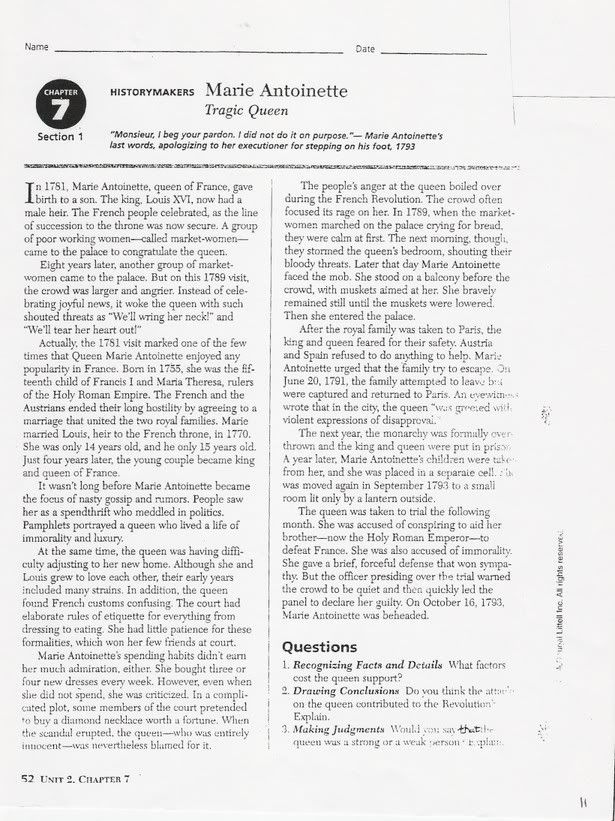
7) Marie Antoinette Video Notes
8) The Execution of Louis XVI (ask Mr P for a copy if you cannot read the worksheet online. Also, answer the questions on your own sheet of paper.)
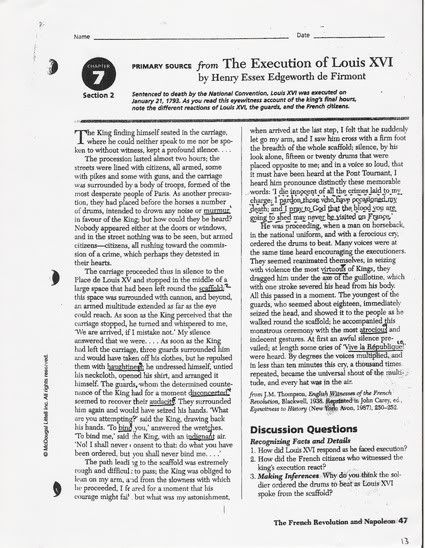
9) Guided Notes
10) 6 Stages Chart &
FRENCH REVOLUTION POWER POINTS
Use Technical Thompson's Website and scroll down to the unit on French Revolution for help with Assignments 1-10.
Sketch's Website has French Revolution Vocab help. Thanks Sketch! Gee, thanks for making class for students that much more simple. Students should use Sketch's Vocab help but write down definitions using their own West High vernacular. Mr. P will NOT give students credit if they copy Sketch's definitions word for word. Also, Sketch was known for pulling off clever tricks like giving the wrong definition at times to make sure students are thinking and NOT just copying definitions. It is best to check Sketch's definitions against other sources.
C & C French Revolution Vocab help. Same rules mentioned above for Sketch's website applies here.
For students seeking additional reading on the French Revolution, Mr P's Random French Revolution Book Picks for Students are:
a) French Revolution for Beginners by Martin McCrory & Robert Moulder
b) A Short History of the French Revolution by Jeremy Popkin
c) The French Revolution & Napoleonic Era by Owen Connelly
MONDAY November 3, 2008
1) Post Halloween
2) MC Exam Results
3) School Year Thus Far
4) P-Ville Talk
a) Order & Stability Check
b) Daily Announcements
c) Glorious Race
d) Weekly Meetings
5) Start French Revolution
a) TOC
b) K.W.L.
c) Pie Chart
d) 6 Stages of FR
e) Vocabulary
HW:
a) Read p.107-113
b) Start Vocabulary (Assign #3) - Vocab help above
c) Complete Pie Chart (Assign #4)
d) Revolution Threatens the King (Assign #5)
Need help studying for the Geo Retake? Use Sketch's Geo Review. Let Mr P know if it is helpful so he could email Sketch.
TUESDAY November 4, 2008
1) Pie Chart (Assign #4) - Review
2) 6 Stages of French Revolution (Assign #10) - Review
3) Revolution Threatens the King (Assign #5) - Review
HW:
a) Read Section 2 & 3 from Textbook p. 114 - 125
b) Guided Reading Notes for Section 2 & 3 (Assign #9)
b) Complete Vocab (Assign #3) & Study for Vocab Game
c) Marie Antoinette (Assign #6) Read and Answer Questions
d) King Louis' Execution (Assign #8) Read and Answer Questions
Need help studying for the Geo Retake? Use Sketch's Geo Review. Let Mr P know if it is helpful so he could email Sketch.
WEDNESDAY November 5, 2008
1) Order & Stability or SSR for Assign 6-8
2) 6 Stages of French Revolution (Assign #10)- Review
3) Guided Notes (Assign #9) - Review
4) Political Spectrum (Assign #9) - Review
5) Short Video on Marie Antoinette (If time permits. Otherwise, omit assignment #7)
HW
a) Organize & STAPLE French Revolution Packet (Assign 1-10)
b) Study for French Revolution Mini - Exam
Suggestions for Studying:
1) Review Vocab (Assign #3) - Use Sketch's French Revolution Vocab Review and C & C French Revolution Vocab help.
2) Review Pie Chart (Assign #4)
3) Review Revolution Threatens King (Assign #5)
4) Review Guided Notes (Assign #9)
5) Review 6 Stages (Assign #10)
6) Take P Alumni Peymaneh's Quizzes on the French Revolution. Peymaneh's created these quizzes based reading from the old World History textbook. Still, the questions are generally useful for any quiz on the French Revolution. Peymaneh created this legacy project only after living in the US for 8 months. Some of her quiz questions do contain grammar and spelling errors. Mr. P did NOT correct them on purpose. He wanted to also showcase this legacy project to demonstrate what a student can produce despite facing academic setbacks (i.e. Learning a new language and adapting to a new culture). Are you a student facing your own academic setbacks? Mr P challenges you to step it up like Paymaneh, overcome academic set backs and create a legacy project that can be used by students in the future!
NOTICE: Geo Retake will be offered once again at 3:22pm. This will be the 6th offering of the Geo Retake. Come by, ace the Geo Retake and have your original Geo Exam score changed to a perfect score of 40/40. Wow! What an offer! Don't pass up it up, especially if your grade in class is low.
c) Need help studying for the Geo Retake?
Use Sketch's Geo Review. Let Mr P know if it is helpful so he could email Sketch. Not only is she a cool P Alumni but also a Geo Hall of Famer. Other cool stats about Sketch. She is about to graduate from college with a degree in English. Aside from being a college student, she works at Disneyland. She's traveled to Europe a few times. Mr. P and other teachers like Mrs Cerda will always positively remember Sketch as a silent-but-deadly student. She was one who was generally quiet, smart, did high quality work, cared about learning and obviously was a deep thinker. How will Mr P and other teachers remember you? Will they remember you at all?
THURSDAY November 6, 2008
1) Order & Stability Check
2) Vocab Game
3) Simple Quiz
4) MC French Revolution Review Quiz
HW
a) Study for French Revolution Mini-Exam
b) Organize & STAPLE French Revolution Packet (Assign 1-10)
FRIDAY November 7, 2008
1) Turn in French Revolution Packet (Assign 1-10) before tardy bell
2) Review Simple Quiz
3) French Revolution Mini-Exam
4) Start Napoleon (Day 1)
HW
a) Read The Age of Napoleon p. 128-136
b) Legacy Project approval deadline is Friday, November 14th
c) Semester Final is either the Final Exam or a Legacy Project. All students wishing to do a Legacy Project must get approval from Mr. P prior to November 15th.
d) All students not doing a Legacy Project will take a semester Final Exam. The Final Exam is multiple choice. Questions for the multiple choice exam will be cumulative. Thus, any content covered during the first semester can appear on the Semester Final Exam.
e) The Semester Final will be at the end of January. Students taking the Final Exam will take it at the end of January. Students doing a legacy project will turn it in the day the students (not doing a legacy project) take the Semester Final Exam.
SEMESTER FINAL
LEGACY PROJECT OR FINAL EXAM
Each semester students will have a choice of taking either the Final Exam or doing a Legacy Project as their ‘semester’ final. The semester final (exam or project) will equate to 20% - 25 % of the student’s semester grade. There is an application and qualification process that involves doing a legacy project. All students who do not apply or qualify to do a Legacy Project will partake in Final Exam process as a means of fulfilling their semester final obligation for the course. Written below are the specifics for both the Legacy Project and Final Exam.
LEGACY PROJECT
There are several purposes for students to apply to do a legacy project.
1) Students want to create a project to assist & inspire future students’ learning.
2) Students actually want to make a difference and contribute to the betterment of Mr. P’s class.
3) Students prefer to create a project versus taking an Exam for a final.
All student interested in doing a Legacy Project for their semester final must apply and qualify to do a legacy project. To apply and qualify for the Legacy Project, students must submit at least 3 typed proposals to Mr. P. In addition, students are required to schedule a brief meeting with Mr P after school to explain their legacy project proposals. Basically, students are to ‘sell’ their legacy project idea to Mr. P. Students will “qualify” to do a legacy project, if students convince Mr. P of the usefulness of their Legacy Proposal(s). Students should bring their 3 typed legacy proposals and explain them to Mr. P. At the after school meeting, students MUST do the following:
A) Be prepared, articulate and brief (Mr. P is a busy guy and doesn’t like to waste time)
B) Quickly & clearly explain to Mr. P your Legacy ideas (Mr. P has to be able to understand what it is)
C) Explain how it will be beneficial to future students, Mr. P, etc.
D) A typed working schedule that explains how you will be completing the project
E) Samples that demonstrate your ability to do certain kinds of work (i.e. your artwork, video equipment, computer skills or previous projects your done).
The deadline to apply and qualify for doing a Legacy Project as a student’s “Final” for the semester will be October 31st (Halloween). If a student does not apply and qualify by this date, the student will then, by way of default, partake in the Final Exam process at the end of the semester. If a student qualifies and agrees to do a Legacy Project, then he/she is committed to doing a Legacy Project. They will not be allowed to change from doing a Legacy Project to taking the “Final Exam.”
GROUP or SOLO WORK: Mr. P highly recommends that students work solo on their legacy project. Once again, he advises students do NOT work with other students. However, students might be allowed to work with others if they can justify the need to have more than one person do the project. Yet, the group work limit is 3 students. Students may also work with students in Mr. P’s other World History classes. Most importantly, if students qualify to work in a group it is entirely their choice and responsibility to do so. Mr. P will NOT, once again, will NOT hear any grievances or feel any sympathy pertaining to group work problems. Group work is a choice of the students. Again, Mr. P suggests students do NOT work in groups. Yet, students are old enough to make their own decision on such matter.
LEGACY GRADING SYSTEM:
A Grade:
Most likely any legacy project that will be or is actually used in Mr. P’s class achieves an “A” grade. If Mr. P will not use it in the future, it probably is NOT going to get an “A” grade. Legacy projects rarely take 1 day or 1 weekend to complete. Students with a desire to achieve an “A” should put in a fair amount of time and effort to complete their legacy project. However, time and effort does NOT necessarily equate to an “A” grade. Students can work very hard and still not achieve an “A” grade. The project should be of the utmost quality. It should also be ready for classroom use. Usually any needed adjustments that Mr. P has to do will deduct from the grade of the Legacy Project. All students witness how Mr. P runs the class on a daily basis. Students should become aware of what is “needed” and what “works” with regards to legacy projects. Also, “A” legacy projects are well labeled, packaged, easily stored or accessed. Presentation of the Legacy Project is memorable. It is NOT just another boring final presentation. Fellow students believe the project is useful and of quality.
B Grade:
Usually a good legacy project but does not do all the requirements listed for an “A” grade. Most likely, a “B” grade results because Mr. P will have to “adjust” the project so that it can be used in class. “B” rate Legacy Projects lack the originality, usefulness and quality in comparison to “A” rate Legacy Projects. Presentation of the project is above average and is somewhat memorable.
C Grade:
Results when the Legacy Project will NOT be used in the classroom. It does NOT fulfill the general standards of a “B” grade. Presentation of the project is average and is NOT memorable.
D Grade:
“D” stands for Disappointment. This project is obviously substandard to what is expected of Legacy Projects. It appears to be done quickly and with substandard care. It will NOT be used in the classroom. Presentation is unprepared, robotic and/or boring.
F Grade:
Produces an overall gross Legacy Project. There is a sense of making a mockery out of doing the Legacy Project. Unorganized and poor presentation. If anything, this project serves as a sample of what NOT to do for a Legacy Project.
FINAL EXAM
The Final Exam will take place the day of the scheduled final in late January for the fall semester and in June for the spring semester. The Final Exam will consist of approximately 200 multiple choice questions. The questions will be related to the unit topics covered during the semester. Students are welcome to pick the Final Exam as their semester final.
180 – 200 correct; 90% - 100% = A
160 – 179 correct; 80% - 89% = B
140 – 159 correct; 70% - 79% = C
120 – 139 correct; 60% - 69% = D
0 – 119 correct; 0 - 59% = F
WORLD HISTORY UNITS
FALL SEMESTER
1) Geography
2) Autocracy vs Democracy
3) Middle Ages – American Revolution
4) French Revolution & Napoleon
5) Industrial Revolution
6) Nationalism & Imperialism
7) WWI
SPRING SEMESTER
1) Geography
8) 20th Century Revolution & Nationalism
9) WWII
10) Cold War
11) Current Issues
Jazz is original American music.
One thing Leads to Another
was a good 80s song by the Fixx
The Ways
French Revolution for Beginners is a a solid little book for those interested in knowing a little bit more about the French Revolution
Ask Mr P about it
Sunday, October 26, 2008
Unit 3: Middle Ages - American Revolution
This is class news for the week of October 27 - 31, 2008
UPCOMING EXAM INFORMATION
Coming Soon: Unit Exam will be Thursday October 30, 2008.
Submit your own test questions ideas into Mr P’s comment box. If they are good, Mr P will put them on the test. Wow!
Two types of exams will be available to students for this unit.
1) Exam A will be for most students:
Part I - Spectrum of Time & One Thing Leads to Another (Pretest – all students have this already. It is assignment #2. This should be easy for students to perform on this part of the exam, since students know what to expect and were given Part I – 3 weeks before the exam)
Part II – Multiple Choice (MC) – Questions will come from the various themes of the unit (ie Middle Ages, Renaissance, North Renaissance, etc.) Mr P makes up MC test questions based on the unit assignments. Hence, the best way to study for the test is to review your Unit Assignments. The assignments are listed further below.
2) Exam B is for students looking for an academic challenge. These are students who think they might go to college to major in history, political science, philosophy or join an AP history class in the future:
Part I – Spectrum of Time & One Thing Leads To Another (same as Exam A)
Part II – In-class Essay Response – Essay Questions will be very broad so students could write an essay using and showing the wide variety of the content they learned from the unit. The point value of the Essay Response will be weighed the same as the MC portion of Exam A.
If you plan to do Exam B, let Mr. P know in advance. Ask for the Exam B sign up sheet or leave a message in his comment box with your name and reason why you’d like to take Exam B. Otherwise, you will take Exam A.
Themes of Unit 3: Middle Ages to American Revolution
1) Middle Ages
2) Renaissance
3) Northern Renaissance
4) Exploration
5) Reformation
6) Scientific Revolution
7) Enlightenment
8) American Revolution
Table of Contents for Unit Assignments – Due Thursday October 30, 2008
1) TOC
2) Spectrum of Time / One Thing Leads to Another (Pre Test)
3) Vocab List (Students will not have to write out but are expected to know vocab)
4) 8 Middle Age Questions (Read Small File or Larger File to answer 8 questions)
5) Renaissance Basics
6) Renaissance People
7) North Renaissance Notes - Power Point & Worksheet
8) Exploration Notes
9) Reformation Notes
10) Scientific Revolution
11) Enlightenment Questions
12) Enlightenment Thinkers
13) American Revolution & Constitution Notes
14) Democracy in Action (Omit this assignment)
MONDAY October 27, 2008
1) Mr P will start class off by asking each student: Semester Final: What are you going to do?
- The Final Exam or Final Project?
- Deadline to decide has been extended to Friday November 7th, 2008.
- Finals will be the last week of the semester (End of January)
- The Final Exam
a) It will be a 100 Multiple Choice Question Cumulative Exam.
b) Cumulative exams cover content studied throughout the semester (Sept – January)
Final Projects (Legacy Projects)
a) All must be approved by Mr P prior to November 7th, 2008
b) All students NOT approved to do Legacy Projects will take the Final Exam
SCROLL DOWN below this week’s agenda to read the details about the Semester Project.
2) Enlightenment People
3) Middle Ages - American Revolution Recap
HW:
a)Have Organized and Completed Assignments 1-13
TUESDAY October 28, 2008
1) American Revolution & Constitution
2) Middle Ages - American Revolution Review for Exam
HW:
a) Organized and Complete Assign 1-13
b) Review and read over Assign 1-13
c) Review Vocab (Assign #3)
The exam will be just before Halloween on Thursday October 30, 2008.
All students should practice and drill Assignment #2 outside of class in order to do well on the exam. Assignment #2 is the Spectrum of Time / One Thing Leads to Another worksheet.
Mr P says students should be sure to practice each day for about 10 – 15 minutes. Come the day of the exam, Part I should be really easy. Well, it will be, if you prepare for it.
Also, Mr. P suggests studying and drilling with fellow classmates. Create competitions who can complete Part I the fastest, who can name the most historical people and things with each theme. As Mr. P’s old Auntie Kitty use to say, “Hava fun, kids!”
c) Need help studying for the Geo Retake Exam. Check out a P Alumni's cool Legacy Project from a few years back. Sketch's Website
WEDNESDAY October 29, 2008
1) Recap American Revolution and Constitution (Assign 13)
2) Review for Exam
HW:
a)Study for Exam tomorrow
THURSDAY October 30, 2008
1) Middle Ages - American Revolution Packet Due before Tardy Bell (Assign 1-13)
2) Middle Ages - American Revolution Exam
HW:
a) None for Monday
b) Need help studying for the Geo Retake Exam. Check out a P Alumni's cool Legacy Project from a few years back. Sketch's Website
FRIDAY October 31, 2008
1) Happy Halloween
2) Lesson TBA (Sub)
HW:
a) SEMESTER FINAL: What will be your choice? A) Legacy Project or B) Final Exam
SEMESTER FINAL
LEGACY PROJECT OR FINAL EXAM
Each semester students will have a choice of taking either the Final Exam or doing a Legacy Project as their ‘semester’ final. The semester final (exam or project) will equate to 20% - 25 % of the student’s semester grade. There is an application and qualification process that involves doing a legacy project. All students who do not apply or qualify to do a Legacy Project will partake in Final Exam process as a means of fulfilling their semester final obligation for the course. Written below are the specifics for both the Legacy Project and Final Exam.
LEGACY PROJECT
There are several purposes for students to apply to do a legacy project.
1) Students want to create a project to assist & inspire future students’ learning.
2) Students actually want to make a difference and contribute to the betterment of Mr. P’s class.
3) Students prefer to create a project versus taking an Exam for a final.
All student interested in doing a Legacy Project for their semester final must apply and qualify to do a legacy project. To apply and qualify for the Legacy Project, students must submit at least 3 typed proposals to Mr. P. In addition, students are required to schedule a brief meeting with Mr P after school to explain their legacy project proposals. Basically, students are to ‘sell’ their legacy project idea to Mr. P. Students will “qualify” to do a legacy project, if students convince Mr. P of the usefulness of their Legacy Proposal(s). Students should bring their 3 typed legacy proposals and explain them to Mr. P. At the after school meeting, students MUST do the following:
A) Be prepared, articulate and brief (Mr. P is a busy guy and doesn’t like to waste time)
B) Quickly & clearly explain to Mr. P your Legacy ideas (Mr. P has to be able to understand what it is)
C) Explain how it will be beneficial to future students, Mr. P, etc.
D) A typed working schedule that explains how you will be completing the project
E) Samples that demonstrate your ability to do certain kinds of work (i.e. your artwork, video equipment, computer skills or previous projects you've done).
The deadline to apply and qualify for doing a Legacy Project as a student’s “Final” for the semester will be October 31st (Halloween). If a student does not apply and qualify by this date, the student will then, by way of default, partake in the Final Exam process at the end of the semester. If a student qualifies and agrees to do a Legacy Project, then he/she is committed to doing a Legacy Project. They will not be allowed to change from doing a Legacy Project to taking the “Final Exam.”
GROUP or SOLO WORK: Mr. P highly recommends that students work solo on their legacy project. Once again, he advises students do NOT work with other students. However, students might be allowed to work with others if they can justify the need to have more than one person do the project. Yet, the group work limit is 3 students. Students may also work with students in Mr. P’s other World History classes. Most importantly, if students qualify to work in a group it is entirely their choice and responsibility to do so. Mr. P will NOT, once again, will NOT hear any grievances or feel any sympathy pertaining to group work problems. Group work is a choice of the students. Again, Mr. P suggests students do NOT work in groups. Yet, students are old enough to make their own decision on such matter.
LEGACY GRADING SYSTEM:
A Grade:
Most likely any legacy project that will be or is actually used in Mr. P’s class achieves an “A” grade. If Mr. P will not use it in the future, it probably is NOT going to get an “A” grade. Legacy projects rarely take 1 day or 1 weekend to complete. Students with a desire to achieve an “A” should put in a fair amount of time and effort to complete their legacy project. However, time and effort does NOT necessarily equate to an “A” grade. Students can work very hard and still not achieve an “A” grade. The project should be of the utmost quality. It should also be ready for classroom use. Usually any needed adjustments that Mr. P has to do will deduct from the grade of the Legacy Project. All students witness how Mr. P runs the class on a daily basis. Students should become aware of what is “needed” and what “works” with regards to legacy projects. Also, “A” legacy projects are well labeled, packaged, easily stored or accessed. Presentation of the Legacy Project is memorable. It is NOT just another boring final presentation. Fellow students believe the project is useful and of quality.
B Grade:
Usually a good legacy project but does not do all the requirements listed for an “A” grade. Most likely, a “B” grade results because Mr. P will have to “adjust” the project so that it can be used in class. “B” rate Legacy Projects lack the originality, usefulness and quality in comparison to “A” rate Legacy Projects. Presentation of the project is above average and is somewhat memorable.
C Grade:
Results when the Legacy Project will NOT be used in the classroom. It does NOT fulfill the general standards of a “B” grade. Presentation of the project is average and is NOT memorable.
D Grade:
“D” stands for Disappointment. This project is obviously substandard to what is expected of Legacy Projects. It appears to be done quickly and with substandard care. It will NOT be used in the classroom. Presentation is unprepared, robotic and/or boring.
F Grade:
Produces an overall gross Legacy Project. There is a sense of making a mockery out of doing the Legacy Project. Unorganized and poor presentation. If anything, this project serves as a sample of what NOT to do for a Legacy Project.
FINAL EXAM
The Final Exam will take place the day of the scheduled final in late January for the fall semester and in June for the spring semester. The Final Exam will consist of approximately 200 multiple choice questions. The questions will be related to the unit topics covered during the semester. Students are welcome to pick the Final Exam as their semester final.
180 – 200 correct; 90% - 100% = A
160 – 179 correct; 80% - 89% = B
140 – 159 correct; 70% - 79% = C
120 – 139 correct; 60% - 69% = D
0 – 119 correct; 0 - 59% = F
WORLD HISTORY UNITS
FALL SEMESTER
1) Geography
2) Autocracy vs Democracy
3) Middle Ages – American Revolution
4) French Revolution & Napoleon
5) Industrial Revolution
6) Nationalism & Imperialism
7) WWI
SPRING SEMESTER
1) Geography
8) 20th Century Revolution & Nationalism
9) WWII
10) Cold War
11) Current Issues
How did you like this unit? Let Mr P know. Leave a message in his comment box.
This is class news for the week of October 27 - 31, 2008
UPCOMING EXAM INFORMATION
Coming Soon: Unit Exam will be Thursday October 30, 2008.
Submit your own test questions ideas into Mr P’s comment box. If they are good, Mr P will put them on the test. Wow!
Two types of exams will be available to students for this unit.
1) Exam A will be for most students:
Part I - Spectrum of Time & One Thing Leads to Another (Pretest – all students have this already. It is assignment #2. This should be easy for students to perform on this part of the exam, since students know what to expect and were given Part I – 3 weeks before the exam)
Part II – Multiple Choice (MC) – Questions will come from the various themes of the unit (ie Middle Ages, Renaissance, North Renaissance, etc.) Mr P makes up MC test questions based on the unit assignments. Hence, the best way to study for the test is to review your Unit Assignments. The assignments are listed further below.
2) Exam B is for students looking for an academic challenge. These are students who think they might go to college to major in history, political science, philosophy or join an AP history class in the future:
Part I – Spectrum of Time & One Thing Leads To Another (same as Exam A)
Part II – In-class Essay Response – Essay Questions will be very broad so students could write an essay using and showing the wide variety of the content they learned from the unit. The point value of the Essay Response will be weighed the same as the MC portion of Exam A.
If you plan to do Exam B, let Mr. P know in advance. Ask for the Exam B sign up sheet or leave a message in his comment box with your name and reason why you’d like to take Exam B. Otherwise, you will take Exam A.
Themes of Unit 3: Middle Ages to American Revolution
1) Middle Ages
2) Renaissance
3) Northern Renaissance
4) Exploration
5) Reformation
6) Scientific Revolution
7) Enlightenment
8) American Revolution
Table of Contents for Unit Assignments – Due Thursday October 30, 2008
1) TOC
2) Spectrum of Time / One Thing Leads to Another (Pre Test)
3) Vocab List (Students will not have to write out but are expected to know vocab)
4) 8 Middle Age Questions (Read Small File or Larger File to answer 8 questions)
5) Renaissance Basics
6) Renaissance People
7) North Renaissance Notes - Power Point & Worksheet
8) Exploration Notes
9) Reformation Notes
10) Scientific Revolution
11) Enlightenment Questions
12) Enlightenment Thinkers
13) American Revolution & Constitution Notes
14) Democracy in Action (Omit this assignment)
MONDAY October 27, 2008
1) Mr P will start class off by asking each student: Semester Final: What are you going to do?
- The Final Exam or Final Project?
- Deadline to decide has been extended to Friday November 7th, 2008.
- Finals will be the last week of the semester (End of January)
- The Final Exam
a) It will be a 100 Multiple Choice Question Cumulative Exam.
b) Cumulative exams cover content studied throughout the semester (Sept – January)
Final Projects (Legacy Projects)
a) All must be approved by Mr P prior to November 7th, 2008
b) All students NOT approved to do Legacy Projects will take the Final Exam
SCROLL DOWN below this week’s agenda to read the details about the Semester Project.
2) Enlightenment People
3) Middle Ages - American Revolution Recap
HW:
a)Have Organized and Completed Assignments 1-13
TUESDAY October 28, 2008
1) American Revolution & Constitution
2) Middle Ages - American Revolution Review for Exam
HW:
a) Organized and Complete Assign 1-13
b) Review and read over Assign 1-13
c) Review Vocab (Assign #3)
The exam will be just before Halloween on Thursday October 30, 2008.
All students should practice and drill Assignment #2 outside of class in order to do well on the exam. Assignment #2 is the Spectrum of Time / One Thing Leads to Another worksheet.
Mr P says students should be sure to practice each day for about 10 – 15 minutes. Come the day of the exam, Part I should be really easy. Well, it will be, if you prepare for it.
Also, Mr. P suggests studying and drilling with fellow classmates. Create competitions who can complete Part I the fastest, who can name the most historical people and things with each theme. As Mr. P’s old Auntie Kitty use to say, “Hava fun, kids!”
c) Need help studying for the Geo Retake Exam. Check out a P Alumni's cool Legacy Project from a few years back. Sketch's Website
WEDNESDAY October 29, 2008
1) Recap American Revolution and Constitution (Assign 13)
2) Review for Exam
HW:
a)Study for Exam tomorrow
THURSDAY October 30, 2008
1) Middle Ages - American Revolution Packet Due before Tardy Bell (Assign 1-13)
2) Middle Ages - American Revolution Exam
HW:
a) None for Monday
b) Need help studying for the Geo Retake Exam. Check out a P Alumni's cool Legacy Project from a few years back. Sketch's Website
FRIDAY October 31, 2008
1) Happy Halloween
2) Lesson TBA (Sub)
HW:
a) SEMESTER FINAL: What will be your choice? A) Legacy Project or B) Final Exam
SEMESTER FINAL
LEGACY PROJECT OR FINAL EXAM
Each semester students will have a choice of taking either the Final Exam or doing a Legacy Project as their ‘semester’ final. The semester final (exam or project) will equate to 20% - 25 % of the student’s semester grade. There is an application and qualification process that involves doing a legacy project. All students who do not apply or qualify to do a Legacy Project will partake in Final Exam process as a means of fulfilling their semester final obligation for the course. Written below are the specifics for both the Legacy Project and Final Exam.
LEGACY PROJECT
There are several purposes for students to apply to do a legacy project.
1) Students want to create a project to assist & inspire future students’ learning.
2) Students actually want to make a difference and contribute to the betterment of Mr. P’s class.
3) Students prefer to create a project versus taking an Exam for a final.
All student interested in doing a Legacy Project for their semester final must apply and qualify to do a legacy project. To apply and qualify for the Legacy Project, students must submit at least 3 typed proposals to Mr. P. In addition, students are required to schedule a brief meeting with Mr P after school to explain their legacy project proposals. Basically, students are to ‘sell’ their legacy project idea to Mr. P. Students will “qualify” to do a legacy project, if students convince Mr. P of the usefulness of their Legacy Proposal(s). Students should bring their 3 typed legacy proposals and explain them to Mr. P. At the after school meeting, students MUST do the following:
A) Be prepared, articulate and brief (Mr. P is a busy guy and doesn’t like to waste time)
B) Quickly & clearly explain to Mr. P your Legacy ideas (Mr. P has to be able to understand what it is)
C) Explain how it will be beneficial to future students, Mr. P, etc.
D) A typed working schedule that explains how you will be completing the project
E) Samples that demonstrate your ability to do certain kinds of work (i.e. your artwork, video equipment, computer skills or previous projects you've done).
The deadline to apply and qualify for doing a Legacy Project as a student’s “Final” for the semester will be October 31st (Halloween). If a student does not apply and qualify by this date, the student will then, by way of default, partake in the Final Exam process at the end of the semester. If a student qualifies and agrees to do a Legacy Project, then he/she is committed to doing a Legacy Project. They will not be allowed to change from doing a Legacy Project to taking the “Final Exam.”
GROUP or SOLO WORK: Mr. P highly recommends that students work solo on their legacy project. Once again, he advises students do NOT work with other students. However, students might be allowed to work with others if they can justify the need to have more than one person do the project. Yet, the group work limit is 3 students. Students may also work with students in Mr. P’s other World History classes. Most importantly, if students qualify to work in a group it is entirely their choice and responsibility to do so. Mr. P will NOT, once again, will NOT hear any grievances or feel any sympathy pertaining to group work problems. Group work is a choice of the students. Again, Mr. P suggests students do NOT work in groups. Yet, students are old enough to make their own decision on such matter.
LEGACY GRADING SYSTEM:
A Grade:
Most likely any legacy project that will be or is actually used in Mr. P’s class achieves an “A” grade. If Mr. P will not use it in the future, it probably is NOT going to get an “A” grade. Legacy projects rarely take 1 day or 1 weekend to complete. Students with a desire to achieve an “A” should put in a fair amount of time and effort to complete their legacy project. However, time and effort does NOT necessarily equate to an “A” grade. Students can work very hard and still not achieve an “A” grade. The project should be of the utmost quality. It should also be ready for classroom use. Usually any needed adjustments that Mr. P has to do will deduct from the grade of the Legacy Project. All students witness how Mr. P runs the class on a daily basis. Students should become aware of what is “needed” and what “works” with regards to legacy projects. Also, “A” legacy projects are well labeled, packaged, easily stored or accessed. Presentation of the Legacy Project is memorable. It is NOT just another boring final presentation. Fellow students believe the project is useful and of quality.
B Grade:
Usually a good legacy project but does not do all the requirements listed for an “A” grade. Most likely, a “B” grade results because Mr. P will have to “adjust” the project so that it can be used in class. “B” rate Legacy Projects lack the originality, usefulness and quality in comparison to “A” rate Legacy Projects. Presentation of the project is above average and is somewhat memorable.
C Grade:
Results when the Legacy Project will NOT be used in the classroom. It does NOT fulfill the general standards of a “B” grade. Presentation of the project is average and is NOT memorable.
D Grade:
“D” stands for Disappointment. This project is obviously substandard to what is expected of Legacy Projects. It appears to be done quickly and with substandard care. It will NOT be used in the classroom. Presentation is unprepared, robotic and/or boring.
F Grade:
Produces an overall gross Legacy Project. There is a sense of making a mockery out of doing the Legacy Project. Unorganized and poor presentation. If anything, this project serves as a sample of what NOT to do for a Legacy Project.
FINAL EXAM
The Final Exam will take place the day of the scheduled final in late January for the fall semester and in June for the spring semester. The Final Exam will consist of approximately 200 multiple choice questions. The questions will be related to the unit topics covered during the semester. Students are welcome to pick the Final Exam as their semester final.
180 – 200 correct; 90% - 100% = A
160 – 179 correct; 80% - 89% = B
140 – 159 correct; 70% - 79% = C
120 – 139 correct; 60% - 69% = D
0 – 119 correct; 0 - 59% = F
WORLD HISTORY UNITS
FALL SEMESTER
1) Geography
2) Autocracy vs Democracy
3) Middle Ages – American Revolution
4) French Revolution & Napoleon
5) Industrial Revolution
6) Nationalism & Imperialism
7) WWI
SPRING SEMESTER
1) Geography
8) 20th Century Revolution & Nationalism
9) WWII
10) Cold War
11) Current Issues
How did you like this unit? Let Mr P know. Leave a message in his comment box.
Sunday, October 19, 2008
Unit 3: Middle Ages - American Revolution
This is class news for the week of October 20 - 24, 2008
UPCOMING EXAM INFORMATION
Coming Soon: Unit Exam will be Thursday October 30, 2008.
Submit your own test questions ideas into Mr P’s comment box. If they are good, Mr P will put them on the test. Wow!
Two types of exams will be available to students for this unit.
1) Exam A will be for most students:
Part I - Spectrum of Time & One Thing Leads to Another (Pretest – all students have this already. It is assignment #2. This should be easy for students to perform on this part of the exam, since students know what to expect and were given Part I – 3 weeks before the exam)
Part II – Multiple Choice (MC) – Questions will come from the various themes of the unit (ie Middle Ages, Renaissance, North Renaissance, etc.) Mr P makes up MC test questions based on the unit assignments. Hence, the best way to study for the test is to review your Unit Assignments. The assignments are listed further below.
2) Exam B is for students looking for an academic challenge. These are students who think they might go to college to major in history, political science, philosophy or join an AP history class in the future:
Part I – Spectrum of Time & One Thing Leads To Another (same as Exam A)
Part II – In-class Essay Response – Essay Questions will be very broad so students could write an essay using and showing the wide variety of the content they learned from the unit. The point value of the Essay Response will be weighed the same as the MC portion of Exam A.
NOTE: If you plan to do Exam B, let Mr. P know in advance. Ask for the Exam B sign up sheet or leave a message in his comment box with your name and reason why you’d like to take Exam B. Otherwise, you will take Exam A.
Themes of Unit 3: Middle Ages to American Revolution
1) Middle Ages
2) Renaissance
3) Northern Renaissance
4) Exploration
5) Reformation
6) Scientific Revolution
7) Enlightenment
8) American Revolution
Table of Contents for Unit Assignments – Due Thursday October 30, 2008
1) TOC
2) Spectrum of Time / One Thing Leads to Another (Pre Test)
3) Vocab List (Students will not have to write out but are expected to know vocab)
4) 8 Middle Age Questions
5) Renaissance Basics
6) Renaissance People
7) North Renaissance Notes - Power Point & Worksheet
8) Exploration Notes
9) Reformation Notes
10) Scientific Revolution
11) Enlightenment Questions
12) Enlightenment Thinkers
13) American Revolution & Constitution Notes
14) Democracy in Action
MONDAY October 20, 2008
1) Mr P will start class off by asking each student: Semester Final: What are you going to do?
- The Final Exam or Final Project?
- Deadline to decide has been extended to Friday November 7th, 2008.
- Finals will be the last week of the semester (End of January)
- The Final Exam
a) It will be a 100 Multiple Choice Question Cumulative Exam.
b) Cumulative exams cover content studied throughout the semester (Sept – January)
Final Projects (Legacy Projects)
a) All must be approved by Mr P prior to November 7th, 2008
b) All students NOT approved to do Legacy Projects will take the Final Exam
SCROLL DOWN below this week’s agenda to read the details about the Semester Project.
2) Spectrum of Time Drill
2) P-ville Election Results
3) Exploration Notes (Assign #8)
HW:
a)Complete Exploration Notes
- Extra worksheet here
- Power Point here (Mr P is working to revise the old Exploration Power Pt right now (Sunday night). He will NOT have the new one up on his website until at least 10pm on Sunday evening. If this is beyond your bedtime, then go to sleep. You can get the notes tomorrow. If you are a night owl, check back during the night for Mr P Website updates. Thanks.)
b)Reformation (Assign #9)
- Worksheet here
- Power Point here
- Complete Notes Online or come by after school today.
- Reformation will be reviewed in class on tomorrow (Tuesday)
TUESDAY October 21, 2008
1) Reformation Review (Assign #9)
2) One Thing Leads to Another / Spectrum of Time Drill (Review Assign #2)
HW:
a) Complete Scientific Revolution Notes (Assign #10)
- Extra Worksheet here
- Power Point here
b) Preparing for the Exam
Assignment #2 is also Part I of the upcoming exam. Mr. P is, not only a generous guy, but he wants to see all his students do well in class. So he has given you Part I (Assign #2) three weeks prior to the exam so students can do well on that memorization part of the exam.
The exam will be just before Halloween.
All students should practice and drill Assignment #2 outside of class in order to do well on the exam. Assignment #2 is the Spectrum of Time / One Thing Leads to Another worksheet.
Mr P says students should be sure to practice each day for about 10 – 15 minutes. Come the day of the exam, Part I should be really easy. Well, it will be, if you prepare for it.
Also, Mr. P suggests studying and drilling with fellow classmates. Create competitions who can complete Part I the fastest, who can name the most historical people and things with each theme. As Mr. P’s old Auntie Kitty use to say, “Hava fun, kids!”
c) Need help studying for the Geo Retake Exam. Check out a P Alumni's cool Legacy Project from a few years back. Sketch's Website
WEDNESDAY October 22, 2008
1) Quickwrite & Discussion on Scientific Revolution
2) Scientific Revolution Notes
HW:
a) Enlightenment Questions (Assign # 11)
- Extra Worksheet here
- Power Point here
b) Enlightenment Thinkers (Assign #12)
- Extra worksheet here
- No Power Point for this assignment
c) Need help studying for the Geo Retake Exam. Check out a P Alumni's cool Legacy Project from a few years back. Sketch's Website
THURSDAY October 23, 2008
1) Groups go over Enlightenment Questions (Assign #11)
2) Groups go over Enlightenment Thinkers (Assign #12)
HW:
A) All students should have Unit Assignments 1-12 completed, organized in order and ready to present to Mr. P for a ‘order and stability check’ on Friday.
B) Failure to have Assignments prepared for a Mr P check will result in coming after school to do so.
c) Failure to show up after school will result in Mr. P calling home or visiting home to inform parents or your continued failure to act as a responsible student in class.
d) Need help studying for the Geo Retake Exam. Check out a P Alumni's cool Legacy Project from a few years back. Sketch's Website
FRIDAY October 24, 2008
1) Cool People of the Enlightenment
2) Middle Ages – American Revolution Recap
HW:
a) Students should have completed and organized Assignments 1-12
b) Optional: Assignment 13 = American Revolution & Constitution Notes
-Extra Worksheet here
-Power Point here.
The purpose of doing this in advance is so students can concentrate on what is said in class while going over Assignment 13 on Monday. If students don’t do it advance, then they will have to write down the notes from Mr P’s power point in class. Thus, students have to concentrate on writing and NOT listening and thinking about what is being said. Hence, have the notes completed when you get to class on Monday. This will make your learning NOT only more convenient and easier, but better.
C) Preparing for the Exam
Assignment #2 is also Part I of the upcoming exam. Mr. P is, not only a generous guy, but he wants to see all his students do well in class. So he has given you Part I (Assign #2) three weeks prior to the exam so students can do well on that memorization part of the exam.
The exam will be just before Halloween.
All students should practice and drill Assignment #2 outside of class in order to do well on the exam. Assignment #2 is the Spectrum of Time / One Thing Leads to Another worksheet.
Mr P says students should be sure to practice each day for about 10 – 15 minutes. Come the day of the exam, Part I should be really easy. Well, it will be, if you prepare for it.
Also, Mr. P suggests studying and drilling with fellow classmates. Create competitions who can complete Part I the fastest, who can name the most historical people and things with each theme. As Mr. P’s old Auntie Kitty use to say, “Hava fun, kids!”
d) Need help studying for the Geo Retake Exam. Check out a P Alumni's cool Legacy Project from a few years back. Sketch's Website
SEMESTER FINAL
LEGACY PROJECT OR FINAL EXAM
Each semester students will have a choice of taking either the Final Exam or doing a Legacy Project as their ‘semester’ final. The semester final (exam or project) will equate to 20% - 25 % of the student’s semester grade. There is an application and qualification process that involves doing a legacy project. All students who do not apply or qualify to do a Legacy Project will partake in Final Exam process as a means of fulfilling their semester final obligation for the course. Written below are the specifics for both the Legacy Project and Final Exam.
LEGACY PROJECT
There are several purposes for students to apply to do a legacy project.
1) Students want to create a project to assist & inspire future students’ learning.
2) Students actually want to make a difference and contribute to the betterment of Mr. P’s class.
3) Students prefer to create a project versus taking an Exam for a final.
All student interested in doing a Legacy Project for their semester final must apply and qualify to do a legacy project. To apply and qualify for the Legacy Project, students must submit at least 3 typed proposals to Mr. P. In addition, students are required to schedule a brief meeting with Mr P after school to explain their legacy project proposals. Basically, students are to ‘sell’ their legacy project idea to Mr. P. Students will “qualify” to do a legacy project, if students convince Mr. P of the usefulness of their Legacy Proposal(s). Students should bring their 3 typed legacy proposals and explain them to Mr. P. At the after school meeting, students MUST do the following:
A) Be prepared, articulate and brief (Mr. P is a busy guy and doesn’t like to waste time)
B) Quickly & clearly explain to Mr. P your Legacy ideas (Mr. P has to be able to understand what it is)
C) Explain how it will be beneficial to future students, Mr. P, etc.
D) A typed working schedule that explains how you will be completing the project
E) Samples that demonstrate your ability to do certain kinds of work (i.e. your artwork, video equipment, computer skills or previous projects you've done).
The deadline to apply and qualify for doing a Legacy Project as a student’s “Final” for the semester will be October 31st (Halloween). If a student does not apply and qualify by this date, the student will then, by way of default, partake in the Final Exam process at the end of the semester. If a student qualifies and agrees to do a Legacy Project, then he/she is committed to doing a Legacy Project. They will not be allowed to change from doing a Legacy Project to taking the “Final Exam.”
GROUP or SOLO WORK: Mr. P highly recommends that students work solo on their legacy project. Once again, he advises students do NOT work with other students. However, students might be allowed to work with others if they can justify the need to have more than one person do the project. Yet, the group work limit is 3 students. Students may also work with students in Mr. P’s other World History classes. Most importantly, if students qualify to work in a group it is entirely their choice and responsibility to do so. Mr. P will NOT, once again, will NOT hear any grievances or feel any sympathy pertaining to group work problems. Group work is a choice of the students. Again, Mr. P suggests students do NOT work in groups. Yet, students are old enough to make their own decision on such matter.
LEGACY GRADING SYSTEM:
A Grade:
Most likely any legacy project that will be or is actually used in Mr. P’s class achieves an “A” grade. If Mr. P will not use it in the future, it probably is NOT going to get an “A” grade. Legacy projects rarely take 1 day or 1 weekend to complete. Students with a desire to achieve an “A” should put in a fair amount of time and effort to complete their legacy project. However, time and effort does NOT necessarily equate to an “A” grade. Students can work very hard and still not achieve an “A” grade. The project should be of the utmost quality. It should also be ready for classroom use. Usually any needed adjustments that Mr. P has to do will deduct from the grade of the Legacy Project. All students witness how Mr. P runs the class on a daily basis. Students should become aware of what is “needed” and what “works” with regards to legacy projects. Also, “A” legacy projects are well labeled, packaged, easily stored or accessed. Presentation of the Legacy Project is memorable. It is NOT just another boring final presentation. Fellow students believe the project is useful and of quality.
B Grade:
Usually a good legacy project but does not do all the requirements listed for an “A” grade. Most likely, a “B” grade results because Mr. P will have to “adjust” the project so that it can be used in class. “B” rate Legacy Projects lack the originality, usefulness and quality in comparison to “A” rate Legacy Projects. Presentation of the project is above average and is somewhat memorable.
C Grade:
Results when the Legacy Project will NOT be used in the classroom. It does NOT fulfill the general standards of a “B” grade. Presentation of the project is average and is NOT memorable.
D Grade:
“D” stands for Disappointment. This project is obviously substandard to what is expected of Legacy Projects. It appears to be done quickly and with substandard care. It will NOT be used in the classroom. Presentation is unprepared, robotic and/or boring.
F Grade:
Produces an overall gross Legacy Project. There is a sense of making a mockery out of doing the Legacy Project. Unorganized and poor presentation. If anything, this project serves as a sample of what NOT to do for a Legacy Project.
FINAL EXAM
The Final Exam will take place the day of the scheduled final in late January for the fall semester and in June for the spring semester. The Final Exam will consist of approximately 200 multiple choice questions. The questions will be related to the unit topics covered during the semester. Students are welcome to pick the Final Exam as their semester final.
180 – 200 correct; 90% - 100% = A
160 – 179 correct; 80% - 89% = B
140 – 159 correct; 70% - 79% = C
120 – 139 correct; 60% - 69% = D
0 – 119 correct; 0 - 59% = F
WORLD HISTORY UNITS
FALL SEMESTER
1) Geography
2) Autocracy vs Democracy
3) Middle Ages – American Revolution
4) French Revolution & Napoleon
5) Industrial Revolution
6) Nationalism & Imperialism
7) WWI
SPRING SEMESTER
1) Geography
8) 20th Century Revolution & Nationalism
9) WWII
10) Cold War
11) Current Issues
Mr P is trying to make class better and better. What are you doing to make class better?
There has been a fly on the outside of the window for over an hour. He is just hanging out. I wonder when he'll fly away.
Boo! Halloween is coming!
Halloween is Mr P's favorite holiday!
This is class news for the week of October 20 - 24, 2008
UPCOMING EXAM INFORMATION
Coming Soon: Unit Exam will be Thursday October 30, 2008.
Submit your own test questions ideas into Mr P’s comment box. If they are good, Mr P will put them on the test. Wow!
Two types of exams will be available to students for this unit.
1) Exam A will be for most students:
Part I - Spectrum of Time & One Thing Leads to Another (Pretest – all students have this already. It is assignment #2. This should be easy for students to perform on this part of the exam, since students know what to expect and were given Part I – 3 weeks before the exam)
Part II – Multiple Choice (MC) – Questions will come from the various themes of the unit (ie Middle Ages, Renaissance, North Renaissance, etc.) Mr P makes up MC test questions based on the unit assignments. Hence, the best way to study for the test is to review your Unit Assignments. The assignments are listed further below.
2) Exam B is for students looking for an academic challenge. These are students who think they might go to college to major in history, political science, philosophy or join an AP history class in the future:
Part I – Spectrum of Time & One Thing Leads To Another (same as Exam A)
Part II – In-class Essay Response – Essay Questions will be very broad so students could write an essay using and showing the wide variety of the content they learned from the unit. The point value of the Essay Response will be weighed the same as the MC portion of Exam A.
NOTE: If you plan to do Exam B, let Mr. P know in advance. Ask for the Exam B sign up sheet or leave a message in his comment box with your name and reason why you’d like to take Exam B. Otherwise, you will take Exam A.
Themes of Unit 3: Middle Ages to American Revolution
1) Middle Ages
2) Renaissance
3) Northern Renaissance
4) Exploration
5) Reformation
6) Scientific Revolution
7) Enlightenment
8) American Revolution
Table of Contents for Unit Assignments – Due Thursday October 30, 2008
1) TOC
2) Spectrum of Time / One Thing Leads to Another (Pre Test)
3) Vocab List (Students will not have to write out but are expected to know vocab)
4) 8 Middle Age Questions
5) Renaissance Basics
6) Renaissance People
7) North Renaissance Notes - Power Point & Worksheet
8) Exploration Notes
9) Reformation Notes
10) Scientific Revolution
11) Enlightenment Questions
12) Enlightenment Thinkers
13) American Revolution & Constitution Notes
14) Democracy in Action
MONDAY October 20, 2008
1) Mr P will start class off by asking each student: Semester Final: What are you going to do?
- The Final Exam or Final Project?
- Deadline to decide has been extended to Friday November 7th, 2008.
- Finals will be the last week of the semester (End of January)
- The Final Exam
a) It will be a 100 Multiple Choice Question Cumulative Exam.
b) Cumulative exams cover content studied throughout the semester (Sept – January)
Final Projects (Legacy Projects)
a) All must be approved by Mr P prior to November 7th, 2008
b) All students NOT approved to do Legacy Projects will take the Final Exam
SCROLL DOWN below this week’s agenda to read the details about the Semester Project.
2) Spectrum of Time Drill
2) P-ville Election Results
3) Exploration Notes (Assign #8)
HW:
a)Complete Exploration Notes
- Extra worksheet here
- Power Point here (Mr P is working to revise the old Exploration Power Pt right now (Sunday night). He will NOT have the new one up on his website until at least 10pm on Sunday evening. If this is beyond your bedtime, then go to sleep. You can get the notes tomorrow. If you are a night owl, check back during the night for Mr P Website updates. Thanks.)
b)Reformation (Assign #9)
- Worksheet here
- Power Point here
- Complete Notes Online or come by after school today.
- Reformation will be reviewed in class on tomorrow (Tuesday)
TUESDAY October 21, 2008
1) Reformation Review (Assign #9)
2) One Thing Leads to Another / Spectrum of Time Drill (Review Assign #2)
HW:
a) Complete Scientific Revolution Notes (Assign #10)
- Extra Worksheet here
- Power Point here
b) Preparing for the Exam
Assignment #2 is also Part I of the upcoming exam. Mr. P is, not only a generous guy, but he wants to see all his students do well in class. So he has given you Part I (Assign #2) three weeks prior to the exam so students can do well on that memorization part of the exam.
The exam will be just before Halloween.
All students should practice and drill Assignment #2 outside of class in order to do well on the exam. Assignment #2 is the Spectrum of Time / One Thing Leads to Another worksheet.
Mr P says students should be sure to practice each day for about 10 – 15 minutes. Come the day of the exam, Part I should be really easy. Well, it will be, if you prepare for it.
Also, Mr. P suggests studying and drilling with fellow classmates. Create competitions who can complete Part I the fastest, who can name the most historical people and things with each theme. As Mr. P’s old Auntie Kitty use to say, “Hava fun, kids!”
c) Need help studying for the Geo Retake Exam. Check out a P Alumni's cool Legacy Project from a few years back. Sketch's Website
WEDNESDAY October 22, 2008
1) Quickwrite & Discussion on Scientific Revolution
2) Scientific Revolution Notes
HW:
a) Enlightenment Questions (Assign # 11)
- Extra Worksheet here
- Power Point here
b) Enlightenment Thinkers (Assign #12)
- Extra worksheet here
- No Power Point for this assignment
c) Need help studying for the Geo Retake Exam. Check out a P Alumni's cool Legacy Project from a few years back. Sketch's Website
THURSDAY October 23, 2008
1) Groups go over Enlightenment Questions (Assign #11)
2) Groups go over Enlightenment Thinkers (Assign #12)
HW:
A) All students should have Unit Assignments 1-12 completed, organized in order and ready to present to Mr. P for a ‘order and stability check’ on Friday.
B) Failure to have Assignments prepared for a Mr P check will result in coming after school to do so.
c) Failure to show up after school will result in Mr. P calling home or visiting home to inform parents or your continued failure to act as a responsible student in class.
d) Need help studying for the Geo Retake Exam. Check out a P Alumni's cool Legacy Project from a few years back. Sketch's Website
FRIDAY October 24, 2008
1) Cool People of the Enlightenment
2) Middle Ages – American Revolution Recap
HW:
a) Students should have completed and organized Assignments 1-12
b) Optional: Assignment 13 = American Revolution & Constitution Notes
-Extra Worksheet here
-Power Point here.
The purpose of doing this in advance is so students can concentrate on what is said in class while going over Assignment 13 on Monday. If students don’t do it advance, then they will have to write down the notes from Mr P’s power point in class. Thus, students have to concentrate on writing and NOT listening and thinking about what is being said. Hence, have the notes completed when you get to class on Monday. This will make your learning NOT only more convenient and easier, but better.
C) Preparing for the Exam
Assignment #2 is also Part I of the upcoming exam. Mr. P is, not only a generous guy, but he wants to see all his students do well in class. So he has given you Part I (Assign #2) three weeks prior to the exam so students can do well on that memorization part of the exam.
The exam will be just before Halloween.
All students should practice and drill Assignment #2 outside of class in order to do well on the exam. Assignment #2 is the Spectrum of Time / One Thing Leads to Another worksheet.
Mr P says students should be sure to practice each day for about 10 – 15 minutes. Come the day of the exam, Part I should be really easy. Well, it will be, if you prepare for it.
Also, Mr. P suggests studying and drilling with fellow classmates. Create competitions who can complete Part I the fastest, who can name the most historical people and things with each theme. As Mr. P’s old Auntie Kitty use to say, “Hava fun, kids!”
d) Need help studying for the Geo Retake Exam. Check out a P Alumni's cool Legacy Project from a few years back. Sketch's Website
SEMESTER FINAL
LEGACY PROJECT OR FINAL EXAM
Each semester students will have a choice of taking either the Final Exam or doing a Legacy Project as their ‘semester’ final. The semester final (exam or project) will equate to 20% - 25 % of the student’s semester grade. There is an application and qualification process that involves doing a legacy project. All students who do not apply or qualify to do a Legacy Project will partake in Final Exam process as a means of fulfilling their semester final obligation for the course. Written below are the specifics for both the Legacy Project and Final Exam.
LEGACY PROJECT
There are several purposes for students to apply to do a legacy project.
1) Students want to create a project to assist & inspire future students’ learning.
2) Students actually want to make a difference and contribute to the betterment of Mr. P’s class.
3) Students prefer to create a project versus taking an Exam for a final.
All student interested in doing a Legacy Project for their semester final must apply and qualify to do a legacy project. To apply and qualify for the Legacy Project, students must submit at least 3 typed proposals to Mr. P. In addition, students are required to schedule a brief meeting with Mr P after school to explain their legacy project proposals. Basically, students are to ‘sell’ their legacy project idea to Mr. P. Students will “qualify” to do a legacy project, if students convince Mr. P of the usefulness of their Legacy Proposal(s). Students should bring their 3 typed legacy proposals and explain them to Mr. P. At the after school meeting, students MUST do the following:
A) Be prepared, articulate and brief (Mr. P is a busy guy and doesn’t like to waste time)
B) Quickly & clearly explain to Mr. P your Legacy ideas (Mr. P has to be able to understand what it is)
C) Explain how it will be beneficial to future students, Mr. P, etc.
D) A typed working schedule that explains how you will be completing the project
E) Samples that demonstrate your ability to do certain kinds of work (i.e. your artwork, video equipment, computer skills or previous projects you've done).
The deadline to apply and qualify for doing a Legacy Project as a student’s “Final” for the semester will be October 31st (Halloween). If a student does not apply and qualify by this date, the student will then, by way of default, partake in the Final Exam process at the end of the semester. If a student qualifies and agrees to do a Legacy Project, then he/she is committed to doing a Legacy Project. They will not be allowed to change from doing a Legacy Project to taking the “Final Exam.”
GROUP or SOLO WORK: Mr. P highly recommends that students work solo on their legacy project. Once again, he advises students do NOT work with other students. However, students might be allowed to work with others if they can justify the need to have more than one person do the project. Yet, the group work limit is 3 students. Students may also work with students in Mr. P’s other World History classes. Most importantly, if students qualify to work in a group it is entirely their choice and responsibility to do so. Mr. P will NOT, once again, will NOT hear any grievances or feel any sympathy pertaining to group work problems. Group work is a choice of the students. Again, Mr. P suggests students do NOT work in groups. Yet, students are old enough to make their own decision on such matter.
LEGACY GRADING SYSTEM:
A Grade:
Most likely any legacy project that will be or is actually used in Mr. P’s class achieves an “A” grade. If Mr. P will not use it in the future, it probably is NOT going to get an “A” grade. Legacy projects rarely take 1 day or 1 weekend to complete. Students with a desire to achieve an “A” should put in a fair amount of time and effort to complete their legacy project. However, time and effort does NOT necessarily equate to an “A” grade. Students can work very hard and still not achieve an “A” grade. The project should be of the utmost quality. It should also be ready for classroom use. Usually any needed adjustments that Mr. P has to do will deduct from the grade of the Legacy Project. All students witness how Mr. P runs the class on a daily basis. Students should become aware of what is “needed” and what “works” with regards to legacy projects. Also, “A” legacy projects are well labeled, packaged, easily stored or accessed. Presentation of the Legacy Project is memorable. It is NOT just another boring final presentation. Fellow students believe the project is useful and of quality.
B Grade:
Usually a good legacy project but does not do all the requirements listed for an “A” grade. Most likely, a “B” grade results because Mr. P will have to “adjust” the project so that it can be used in class. “B” rate Legacy Projects lack the originality, usefulness and quality in comparison to “A” rate Legacy Projects. Presentation of the project is above average and is somewhat memorable.
C Grade:
Results when the Legacy Project will NOT be used in the classroom. It does NOT fulfill the general standards of a “B” grade. Presentation of the project is average and is NOT memorable.
D Grade:
“D” stands for Disappointment. This project is obviously substandard to what is expected of Legacy Projects. It appears to be done quickly and with substandard care. It will NOT be used in the classroom. Presentation is unprepared, robotic and/or boring.
F Grade:
Produces an overall gross Legacy Project. There is a sense of making a mockery out of doing the Legacy Project. Unorganized and poor presentation. If anything, this project serves as a sample of what NOT to do for a Legacy Project.
FINAL EXAM
The Final Exam will take place the day of the scheduled final in late January for the fall semester and in June for the spring semester. The Final Exam will consist of approximately 200 multiple choice questions. The questions will be related to the unit topics covered during the semester. Students are welcome to pick the Final Exam as their semester final.
180 – 200 correct; 90% - 100% = A
160 – 179 correct; 80% - 89% = B
140 – 159 correct; 70% - 79% = C
120 – 139 correct; 60% - 69% = D
0 – 119 correct; 0 - 59% = F
WORLD HISTORY UNITS
FALL SEMESTER
1) Geography
2) Autocracy vs Democracy
3) Middle Ages – American Revolution
4) French Revolution & Napoleon
5) Industrial Revolution
6) Nationalism & Imperialism
7) WWI
SPRING SEMESTER
1) Geography
8) 20th Century Revolution & Nationalism
9) WWII
10) Cold War
11) Current Issues
Mr P is trying to make class better and better. What are you doing to make class better?
There has been a fly on the outside of the window for over an hour. He is just hanging out. I wonder when he'll fly away.
Boo! Halloween is coming!
Halloween is Mr P's favorite holiday!
Friday, October 10, 2008
Unit 3: Middle Ages - American Revolution
1) Middle Ages
2) Renaissance
3) Northern Renaissance
4) Exploration
5) Reformation
6) Scientific Revolution
7) Enlightenment
8) American Revolution
Table of Contents for Unit Assignments
1) TOC
2) Spectrum of Time / One Thing Leads to Another (Pre Test)
3) Vocab List (Students will not have to write out but are expected to know vocab)
4) 8 Middle Age Questions
5) Renaissance Notes
6) Renaissance Historical People
7) TBA
8) TBA
9) TBA
10) TBA
11) TBA
12) TBA
13) TBA
14) TBA
Read Daily Life in the Middle Ages with 8 questions (small file = limited pictures)
Read Daily Life in the Middle Ages with 8 questions (Big file = more pictures)
8 Middle Age Questions (Assign #4)
Instructions: a) Complete for Monday October 13, 2008.
b) The answer for these 8 questions will be found by reading the worksheet: Daily Life in the Middle Ages that was passed out Friday October 10, 2008 in class.
c) Please return Daily Life in the Middle Ages reading handout to Mr. P on Monday.
1) Why did peasants have to pay a lord?
2) List at least 3 typical duties a serf owed to a lord.
3) What percentage of sacks of grain did each serf get to keep that he or she produced?
4) What were 2 skilled jobs in a village during the Middle Ages?
5) What was the main course for a peasants meal?
6) How often would a peasant eat meat during a meal?
7) Besides starvation what other life threatening situations did a peasant have to deal with during the middle ages? Describe how a peasant might have dealt with this threatening situation.
8) Compare at least 10 differences in the living conditions of peasant conditions and student conditions
Peasant Student
1) _________________________________ 1)_____________________________________
2) _________________________________ 2)_____________________________________
3) _________________________________ 3)_____________________________________
4) _________________________________ 4)_____________________________________
5) _________________________________ 5)_____________________________________
6) _________________________________ 6)_____________________________________
7) _________________________________ 7)_____________________________________
8) _________________________________ 8)_____________________________________
9) _________________________________ 9)_____________________________________
10)_________________________________ 10)____________________________________
MONDAY October 13, 2008
1) Middle Age Cloze Passage - Mini Quiz based on Middle Age Handout, Middle Age Vocab
2) Time to talk about Time (if you did Assign #4 = Middle Age 8 Questions)
3) Misc Time: Supreme Council 30 second Campaign Speeches
HW:
a) Renaissance Notes (Assign #5)
- Click for the Renaissance Basic Outline worksheet
- Click for Power Point presentation
- Click thru Power Point presentation and fill out worksheet
- Bring filled out worksheet to class tomorrow
b) Renaissance Historical People (Assign #6)
- Click here for Renaissance People worksheet
- Print out
- Bring to class and be ready to take down notes as Mr P does his People of the Renaissance mini-lecture.
TUESDAY October 14, 2008
1) Renaissance Review
2) Renaissance Historical Figures
HW:
a) Complete Renaissance Historical Figures (use Mr. P' power point).
b) Complete North Renaissance Basic Notes.
c) Print out North Renaissance Historical people
WEDNESDAY October 15, 2008
1) Possible Renaissance Quiz (Review Assign 5 & 6)
2) Review North Renaissance
3) North Renaissance People
HW:
a) Exploration
-Print worksheet for class
THURSDAY October 16, 2008
1) Exploration
HW:
a) Complete Exploration
b) Print out, fill out Reformation Notes and bring to class tomorrow.
FRIDAY October 17, 2008
1) Reformation Review
HW:
a) None
SEMESTER FINAL
LEGACY PROJECT OR FINAL EXAM
Each semester students will have a choice of taking either the Final Exam or doing a Legacy Project as their ‘semester’ final. The semester final (exam or project) will equate to 20% - 25 % of the student’s semester grade. There is an application and qualification process that involves doing a legacy project. All students who do not apply or qualify to do a Legacy Project will partake in Final Exam process as a means of fulfilling their semester final obligation for the course. Written below are the specifics for both the Legacy Project and Final Exam.
LEGACY PROJECT
There are several purposes for students to apply to do a legacy project.
1) Students want to create a project to assist & inspire future students’ learning.
2) Students actually want to make a difference and contribute to the betterment of Mr. P’s class.
3) Students prefer to create a project versus taking an Exam for a final.
All student interested in doing a Legacy Project for their semester final must apply and qualify to do a legacy project. To apply and qualify for the Legacy Project, students must submit at least 3 typed proposals to Mr. P. In addition, students are required to schedule a brief meeting with Mr P after school to explain their legacy project proposals. Basically, students are to ‘sell’ their legacy project idea to Mr. P. Students will “qualify” to do a legacy project, if students convince Mr. P of the usefulness of their Legacy Proposal(s). Students should bring their 3 typed legacy proposals and explain them to Mr. P. At the after school meeting, students MUST do the following:
A) Be prepared, articulate and brief (Mr. P is a busy guy and doesn’t like to waste time)
B) Quickly & clearly explain to Mr. P your Legacy ideas (Mr. P has to be able to understand what it is)
C) Explain how it will be beneficial to future students, Mr. P, etc.
D) A typed working schedule that explains how you will be completing the project
E) Samples that demonstrate your ability to do certain kinds of work (i.e. your artwork, video equipment, computer skills or previous projects you've done).
The deadline to apply and qualify for doing a Legacy Project as a student’s “Final” for the semester will be October 31st (Halloween). If a student does not apply and qualify by this date, the student will then, by way of default, partake in the Final Exam process at the end of the semester. If a student qualifies and agrees to do a Legacy Project, then he/she is committed to doing a Legacy Project. They will not be allowed to change from doing a Legacy Project to taking the “Final Exam.”
GROUP or SOLO WORK: Mr. P highly recommends that students work solo on their legacy project. Once again, he advises students do NOT work with other students. However, students might be allowed to work with others if they can justify the need to have more than one person do the project. Yet, the group work limit is 3 students. Students may also work with students in Mr. P’s other World History classes. Most importantly, if students qualify to work in a group it is entirely their choice and responsibility to do so. Mr. P will NOT, once again, will NOT hear any grievances or feel any sympathy pertaining to group work problems. Group work is a choice of the students. Again, Mr. P suggests students do NOT work in groups. Yet, students are old enough to make their own decision on such matter.
LEGACY GRADING SYSTEM:
A Grade:
Most likely any legacy project that will be or is actually used in Mr. P’s class achieves an “A” grade. If Mr. P will not use it in the future, it probably is NOT going to get an “A” grade. Legacy projects rarely take 1 day or 1 weekend to complete. Students with a desire to achieve an “A” should put in a fair amount of time and effort to complete their legacy project. However, time and effort does NOT necessarily equate to an “A” grade. Students can work very hard and still not achieve an “A” grade. The project should be of the utmost quality. It should also be ready for classroom use. Usually any needed adjustments that Mr. P has to do will deduct from the grade of the Legacy Project. All students witness how Mr. P runs the class on a daily basis. Students should become aware of what is “needed” and what “works” with regards to legacy projects. Also, “A” legacy projects are well labeled, packaged, easily stored or accessed. Presentation of the Legacy Project is memorable. It is NOT just another boring final presentation. Fellow students believe the project is useful and of quality.
B Grade:
Usually a good legacy project but does not do all the requirements listed for an “A” grade. Most likely, a “B” grade results because Mr. P will have to “adjust” the project so that it can be used in class. “B” rate Legacy Projects lack the originality, usefulness and quality in comparison to “A” rate Legacy Projects. Presentation of the project is above average and is somewhat memorable.
C Grade:
Results when the Legacy Project will NOT be used in the classroom. It does NOT fulfill the general standards of a “B” grade. Presentation of the project is average and is NOT memorable.
D Grade:
“D” stands for Disappointment. This project is obviously substandard to what is expected of Legacy Projects. It appears to be done quickly and with substandard care. It will NOT be used in the classroom. Presentation is unprepared, robotic and/or boring.
F Grade:
Produces an overall gross Legacy Project. There is a sense of making a mockery out of doing the Legacy Project. Unorganized and poor presentation. If anything, this project serves as a sample of what NOT to do for a Legacy Project.
FINAL EXAM
The Final Exam will take place the day of the scheduled final in late January for the fall semester and in June for the spring semester. The Final Exam will consist of approximately 200 multiple choice questions. The questions will be related to the unit topics covered during the semester. Students are welcome to pick the Final Exam as their semester final.
180 – 200 correct; 90% - 100% = A
160 – 179 correct; 80% - 89% = B
140 – 159 correct; 70% - 79% = C
120 – 139 correct; 60% - 69% = D
0 – 119 correct; 0 - 59% = F
WORLD HISTORY UNITS
FALL SEMESTER
1) Geography
2) Autocracy vs Democracy
3) Middle Ages – American Revolution
4) French Revolution & Napoleon
5) Industrial Revolution
6) Nationalism & Imperialism
7) WWI
SPRING SEMESTER
1) Geography
8) 20th Century Revolution & Nationalism
9) WWII
10) Cold War
11) Current Issues
1) Middle Ages
2) Renaissance
3) Northern Renaissance
4) Exploration
5) Reformation
6) Scientific Revolution
7) Enlightenment
8) American Revolution
Table of Contents for Unit Assignments
1) TOC
2) Spectrum of Time / One Thing Leads to Another (Pre Test)
3) Vocab List (Students will not have to write out but are expected to know vocab)
4) 8 Middle Age Questions
5) Renaissance Notes
6) Renaissance Historical People
7) TBA
8) TBA
9) TBA
10) TBA
11) TBA
12) TBA
13) TBA
14) TBA
Read Daily Life in the Middle Ages with 8 questions (small file = limited pictures)
Read Daily Life in the Middle Ages with 8 questions (Big file = more pictures)
8 Middle Age Questions (Assign #4)
Instructions: a) Complete for Monday October 13, 2008.
b) The answer for these 8 questions will be found by reading the worksheet: Daily Life in the Middle Ages that was passed out Friday October 10, 2008 in class.
c) Please return Daily Life in the Middle Ages reading handout to Mr. P on Monday.
1) Why did peasants have to pay a lord?
2) List at least 3 typical duties a serf owed to a lord.
3) What percentage of sacks of grain did each serf get to keep that he or she produced?
4) What were 2 skilled jobs in a village during the Middle Ages?
5) What was the main course for a peasants meal?
6) How often would a peasant eat meat during a meal?
7) Besides starvation what other life threatening situations did a peasant have to deal with during the middle ages? Describe how a peasant might have dealt with this threatening situation.
8) Compare at least 10 differences in the living conditions of peasant conditions and student conditions
Peasant Student
1) _________________________________ 1)_____________________________________
2) _________________________________ 2)_____________________________________
3) _________________________________ 3)_____________________________________
4) _________________________________ 4)_____________________________________
5) _________________________________ 5)_____________________________________
6) _________________________________ 6)_____________________________________
7) _________________________________ 7)_____________________________________
8) _________________________________ 8)_____________________________________
9) _________________________________ 9)_____________________________________
10)_________________________________ 10)____________________________________
MONDAY October 13, 2008
1) Middle Age Cloze Passage - Mini Quiz based on Middle Age Handout, Middle Age Vocab
2) Time to talk about Time (if you did Assign #4 = Middle Age 8 Questions)
3) Misc Time: Supreme Council 30 second Campaign Speeches
HW:
a) Renaissance Notes (Assign #5)
- Click for the Renaissance Basic Outline worksheet
- Click for Power Point presentation
- Click thru Power Point presentation and fill out worksheet
- Bring filled out worksheet to class tomorrow
b) Renaissance Historical People (Assign #6)
- Click here for Renaissance People worksheet
- Print out
- Bring to class and be ready to take down notes as Mr P does his People of the Renaissance mini-lecture.
TUESDAY October 14, 2008
1) Renaissance Review
2) Renaissance Historical Figures
HW:
a) Complete Renaissance Historical Figures (use Mr. P' power point).
b) Complete North Renaissance Basic Notes.
c) Print out North Renaissance Historical people
WEDNESDAY October 15, 2008
1) Possible Renaissance Quiz (Review Assign 5 & 6)
2) Review North Renaissance
3) North Renaissance People
HW:
a) Exploration
-Print worksheet for class
THURSDAY October 16, 2008
1) Exploration
HW:
a) Complete Exploration
b) Print out, fill out Reformation Notes and bring to class tomorrow.
FRIDAY October 17, 2008
1) Reformation Review
HW:
a) None
SEMESTER FINAL
LEGACY PROJECT OR FINAL EXAM
Each semester students will have a choice of taking either the Final Exam or doing a Legacy Project as their ‘semester’ final. The semester final (exam or project) will equate to 20% - 25 % of the student’s semester grade. There is an application and qualification process that involves doing a legacy project. All students who do not apply or qualify to do a Legacy Project will partake in Final Exam process as a means of fulfilling their semester final obligation for the course. Written below are the specifics for both the Legacy Project and Final Exam.
LEGACY PROJECT
There are several purposes for students to apply to do a legacy project.
1) Students want to create a project to assist & inspire future students’ learning.
2) Students actually want to make a difference and contribute to the betterment of Mr. P’s class.
3) Students prefer to create a project versus taking an Exam for a final.
All student interested in doing a Legacy Project for their semester final must apply and qualify to do a legacy project. To apply and qualify for the Legacy Project, students must submit at least 3 typed proposals to Mr. P. In addition, students are required to schedule a brief meeting with Mr P after school to explain their legacy project proposals. Basically, students are to ‘sell’ their legacy project idea to Mr. P. Students will “qualify” to do a legacy project, if students convince Mr. P of the usefulness of their Legacy Proposal(s). Students should bring their 3 typed legacy proposals and explain them to Mr. P. At the after school meeting, students MUST do the following:
A) Be prepared, articulate and brief (Mr. P is a busy guy and doesn’t like to waste time)
B) Quickly & clearly explain to Mr. P your Legacy ideas (Mr. P has to be able to understand what it is)
C) Explain how it will be beneficial to future students, Mr. P, etc.
D) A typed working schedule that explains how you will be completing the project
E) Samples that demonstrate your ability to do certain kinds of work (i.e. your artwork, video equipment, computer skills or previous projects you've done).
The deadline to apply and qualify for doing a Legacy Project as a student’s “Final” for the semester will be October 31st (Halloween). If a student does not apply and qualify by this date, the student will then, by way of default, partake in the Final Exam process at the end of the semester. If a student qualifies and agrees to do a Legacy Project, then he/she is committed to doing a Legacy Project. They will not be allowed to change from doing a Legacy Project to taking the “Final Exam.”
GROUP or SOLO WORK: Mr. P highly recommends that students work solo on their legacy project. Once again, he advises students do NOT work with other students. However, students might be allowed to work with others if they can justify the need to have more than one person do the project. Yet, the group work limit is 3 students. Students may also work with students in Mr. P’s other World History classes. Most importantly, if students qualify to work in a group it is entirely their choice and responsibility to do so. Mr. P will NOT, once again, will NOT hear any grievances or feel any sympathy pertaining to group work problems. Group work is a choice of the students. Again, Mr. P suggests students do NOT work in groups. Yet, students are old enough to make their own decision on such matter.
LEGACY GRADING SYSTEM:
A Grade:
Most likely any legacy project that will be or is actually used in Mr. P’s class achieves an “A” grade. If Mr. P will not use it in the future, it probably is NOT going to get an “A” grade. Legacy projects rarely take 1 day or 1 weekend to complete. Students with a desire to achieve an “A” should put in a fair amount of time and effort to complete their legacy project. However, time and effort does NOT necessarily equate to an “A” grade. Students can work very hard and still not achieve an “A” grade. The project should be of the utmost quality. It should also be ready for classroom use. Usually any needed adjustments that Mr. P has to do will deduct from the grade of the Legacy Project. All students witness how Mr. P runs the class on a daily basis. Students should become aware of what is “needed” and what “works” with regards to legacy projects. Also, “A” legacy projects are well labeled, packaged, easily stored or accessed. Presentation of the Legacy Project is memorable. It is NOT just another boring final presentation. Fellow students believe the project is useful and of quality.
B Grade:
Usually a good legacy project but does not do all the requirements listed for an “A” grade. Most likely, a “B” grade results because Mr. P will have to “adjust” the project so that it can be used in class. “B” rate Legacy Projects lack the originality, usefulness and quality in comparison to “A” rate Legacy Projects. Presentation of the project is above average and is somewhat memorable.
C Grade:
Results when the Legacy Project will NOT be used in the classroom. It does NOT fulfill the general standards of a “B” grade. Presentation of the project is average and is NOT memorable.
D Grade:
“D” stands for Disappointment. This project is obviously substandard to what is expected of Legacy Projects. It appears to be done quickly and with substandard care. It will NOT be used in the classroom. Presentation is unprepared, robotic and/or boring.
F Grade:
Produces an overall gross Legacy Project. There is a sense of making a mockery out of doing the Legacy Project. Unorganized and poor presentation. If anything, this project serves as a sample of what NOT to do for a Legacy Project.
FINAL EXAM
The Final Exam will take place the day of the scheduled final in late January for the fall semester and in June for the spring semester. The Final Exam will consist of approximately 200 multiple choice questions. The questions will be related to the unit topics covered during the semester. Students are welcome to pick the Final Exam as their semester final.
180 – 200 correct; 90% - 100% = A
160 – 179 correct; 80% - 89% = B
140 – 159 correct; 70% - 79% = C
120 – 139 correct; 60% - 69% = D
0 – 119 correct; 0 - 59% = F
WORLD HISTORY UNITS
FALL SEMESTER
1) Geography
2) Autocracy vs Democracy
3) Middle Ages – American Revolution
4) French Revolution & Napoleon
5) Industrial Revolution
6) Nationalism & Imperialism
7) WWI
SPRING SEMESTER
1) Geography
8) 20th Century Revolution & Nationalism
9) WWII
10) Cold War
11) Current Issues
Subscribe to:
Comments (Atom)