Wednesday, May 04, 2011

IF MR P IS AT SCHOOL ON MONDAY, THEN THE CST SUPER STAR COMPETITION WILL CONTINUE AT LUNCH.

GENOCIDE TOPICS

1) Genocide Worksheet & World Map (Incomplete but helpful Power Pt)
2) Jenn Welch's Short Genocide Summaries
3) Scroll down at Technical Thompson's Website Link 1 & Link 2 to find great links of Genocide Topics


Scroll down to very bottom of this page to get Genocide Topics if link to Technical Thompson's Website is not working for you.


POST WAR INDEPENDENCE MOVEMENTS


The India Packet includes post war notes related to Gandhi, Algeria and the Middle East.

India Packet

India Vocab Game List
- Due to Mr P being absent on Friday... The India Packet Vocab Game has been canceled. Spread the word.

LOOKING TO STUDY COLD WAR & OTHER TOPICS?
1) Cold War Summaries
2) Cold War Vocab Game (Thanks Danish)
3) India's Post WWII Independence


INFORMATION FOR ATOMIC BOMB ESSAY
Recently some students got back their WWII Pacific Packet with a notice for them to write an essay on the Atomic Bomb. Mr P said he would be assigning this essay to students who failed to do a decent job on assignment #7 of the WWII Pacific packet. So if you are a student who has to write an atomic bomb essay, there is info below that will assist you in writing your essay. Be sure to do a solid job or run the risk of having Mr P demand you re-write essays until you do a solid job.

7) Atomic Bomb Essay Notes (Word Doc) & (Power Pt)

7a) Kevin Lee's Atomic Bomb Study Guide:
This summarizes some of the big opinions regarding use of the Atomic Bomb.


ESSAY BOMB INFORMATION

ESSAY BUNCH - Here is the online video that explains how to write a 5 paragraph essay. Be sure to follow the basic rules for writing a 5 paragraph essay and avoid having to write your essay over. Mr P is strict with following the essay rules. Good Luck!

ESSAY VIDEO NOTES - This note-taking worksheet will assist you hi-lite the main points of writing a 5 paragraph essay as you watch the Essay Bunch Instructional Video.

ESSAY GRADING RUBRIC
- Click here to see grading scale for how essays are graded

ESSAY SAMPLES - The Good, The Bad and The Ugly - Samples of essays from the past.


PERIOD 5 YEAR BOOK ASSIGNMENT

Get interview questions here


COLD WAR UNIT ASSIGNMENT


For more updates on worksheets, power points, etc. use Technical Thompson's Cold War section of her website. Time willing, expect even more updates to appear here and at Technical Thompson's website as there is always room for updates and improvements.

1) Table of Contents
2) CW Vocabulary (Vocab Game Power Point - Thanks Danish) (CW Leader Timeline)
3) CW Overview: (Worksheet) & (Power Point)
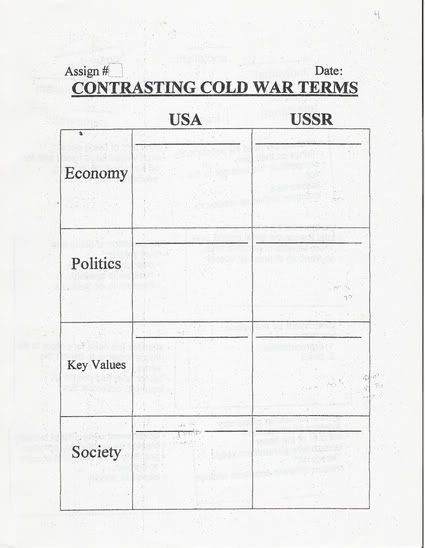
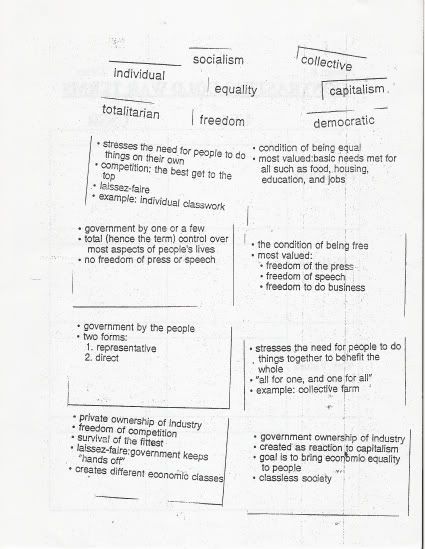
4) Contrasting CW Terms (Front) & (Back)
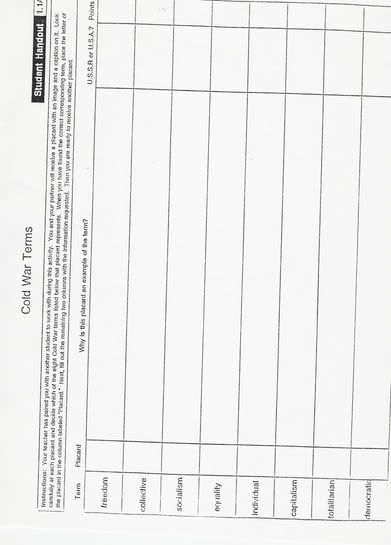
5) CW Terms (8 of Them) (Power Point)
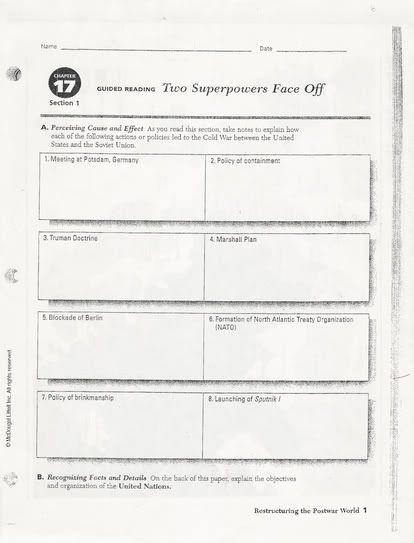
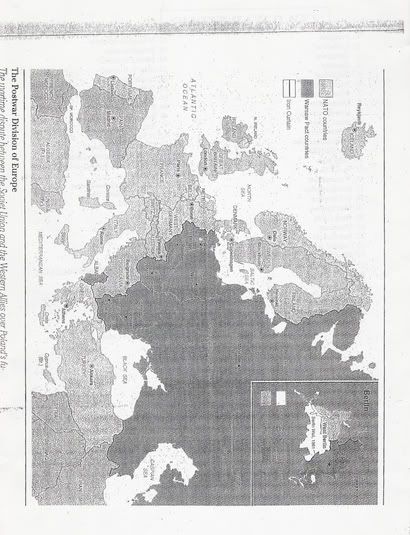
6) 2 Superpowers Face Off (Front = Worksheet) (Back = Europe Reference Map) (Lame Power Pt)
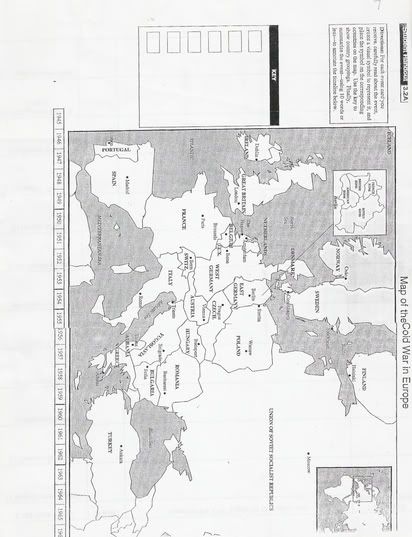
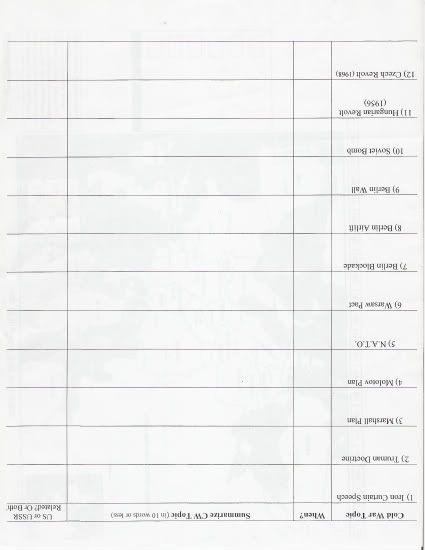
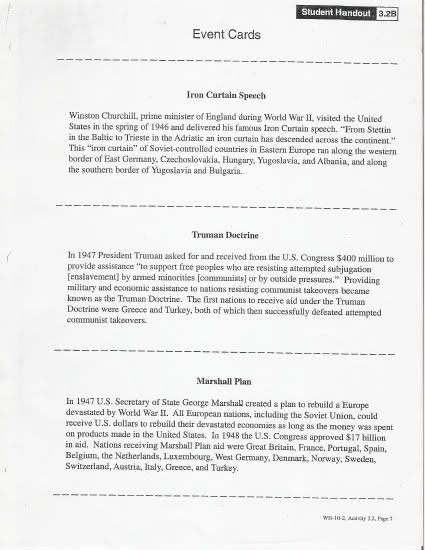
7) CW Map & Timeline (Front = Map) (Back = Timeline) (Event Cards) (1-3) (4-6) (7-9)(10-12) And... Dedicated to immigrants like T. Smith = (Power Point)
8) Iron Curtain Video Notes
9) Arms Race Video Notes & McCarthyism (Video)
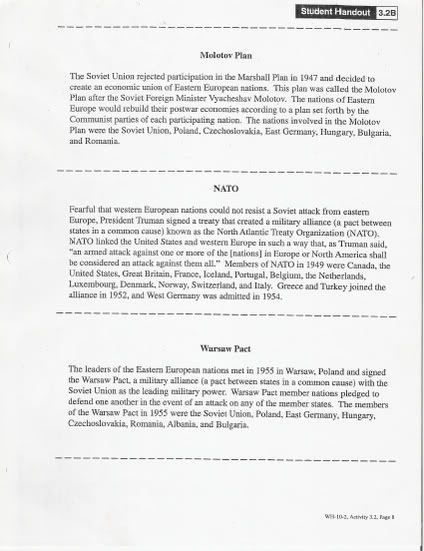
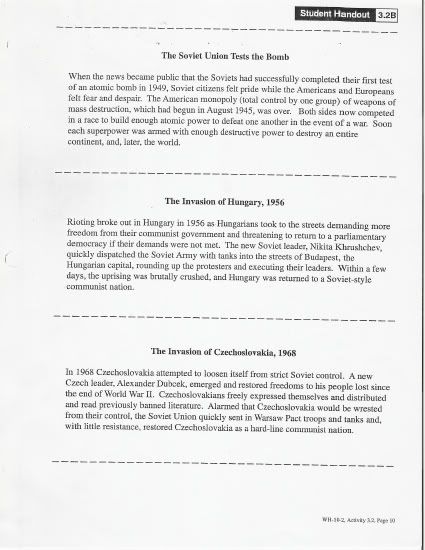
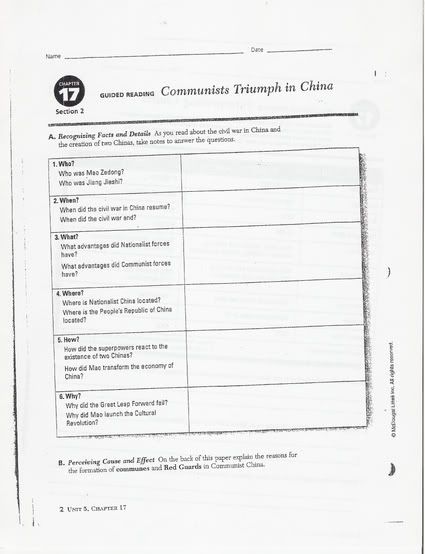
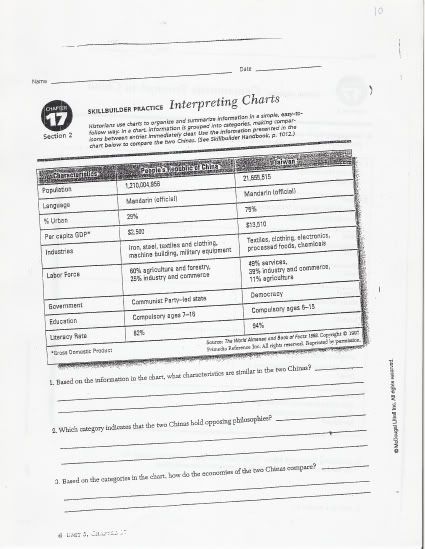
10) Communists In China (Front) (Back) (Video)
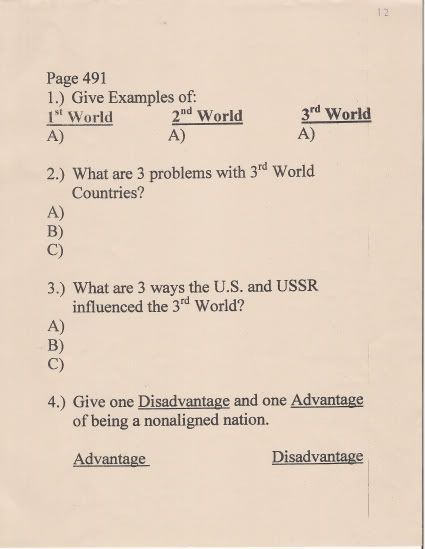
11) Third World Questions (Video)
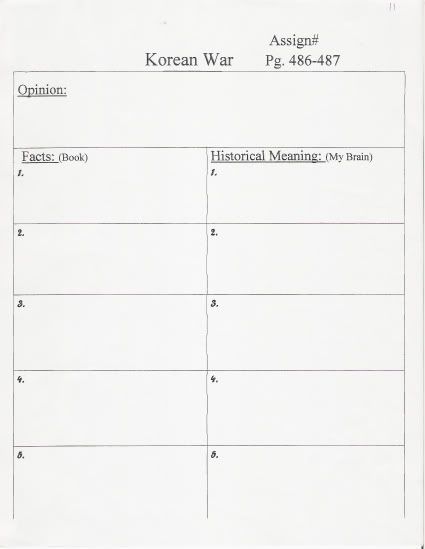
12) Korean War (Worksheet) & (Power Point) (Video)
13) Vietnam Timeline (Video)
14) Quickwrite (Space Race)
15) Latin America Background Notes (Video) & Guatemalan Coup (Video)
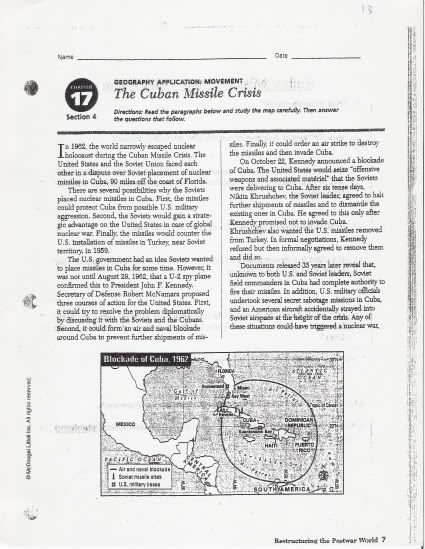
16) Cuban Missile Crisis Video Notes
17) Berlin Wall Video Notes
18) CW Thaws (Worksheet) (Power Point) & Detente 1969 -1975 (Video) & Freeze 1977-1981 (Video) Red Spring (Video)
19) Middle East (Video)
20) Gorbachev, Reagan & The CW Conclusion


PREPARATION FOR FINAL EXAM

HEY! Want to get ready for the Final Exam? Here is some practice Multiple Choice sites

OK folks! The final stretch is here. Most of you have opted to take the final exam. Below are links to practice multiple choice exams. The questions for the final will cover unit content from 2nd semester. These units include:

a) 20th Century Revolutions and Nationalism - Russian, Chinese, India & Algeria
b) Global Depression / Pre WWII / Between the Wars
c) WWII (Europe & Pacific)
d) Holocaust & Genocide
e) Cold War
f) Modern Issues

Study Guide for 2nd Semester Final Exam


MULTIPLE CHOICE (MC) ONLINE QUESTIONS
Mr P suggests checking out the following units to prepare for the final exam:

20th CENTURY REVOLUTION & NATIONALISM
7b) Russian Revolution
8b) Chinese Communist Revolution
8c) Colonial Independence / Collapse of Imperialism

WWII MC QUESTIONS
7c) Between The Wars
7d)WWII

COLD WAR MC QUESTIONS
8a) Cold War
8f) Collapse of Communism

Please email Mr P if you discover any other quality online MC questions. Thanks!


20th Century Genocide Notes (Assign 3) - Students are expected to find out about other 20th Century Genocide besides the Holocaust. Students can use these links below to obtain information on 20th Century Genocide. Students can go to these sites and others to fill out their Genocide Notesheet and World Map.

GOOD INFORMATION:

A) Main Link A - The History Place: Genocide of the 20th Century Great starting point- High school student friendly info gathering website. This site is good because it will provide students with the 'basics' on 20th Century Genocide.

B) Main Link B - Pledge Peace Union contributed by Mizuho (Period 5 All-Star 2005) Quality overview of Genocide.

C)
Main Link C - Genocide Documentation Centre
D) Main Link D - United Human Rights contributed by Mizuho (Period 5 All-Star 2005)

E)
Death Tolls for the Man-made Megadeaths of the 20th Century Alphabetical Index (K-Z) - this resource provides many references on death tolls. Be careful you can get lost on this website for hours. Mr P suggests spending time on this website if you develop a strong interest in the subject of Genocide. If you are just looking to complete the Genocide worksheet, students need not use this site.

LINKS TO GENOCIDE TOPICS

1) Pol Pot Cambodia - Link A, Link B, Link C, Link D (PBS Frontline Documentary - Pol Pot's Shadow)
2) Guatemala - Link A, Link B, Link C, (Genocide Documentary) (Guatemala Doc- Voice from the Mountain)
8) East Timor - Link A, Link B, Link C, Link D (Pilger's Documentary)
9) Burundi - Link A, Link B, Link C, Link D
10) Stalin's Famine -
Link A, Link B,
Link C, Link D

11) Know of other Genocides? (Current?)

ASSIST IN THE LEARNING PROCESS! LET MR. P KNOW IF YOU FIND ANY OTHER QUALITY SITES OR INFORMATION ON GENOCIDE.


LEGACY PROJECT INFORMATION


A) Legacy Project approval deadline was St Patrick's Day (March 17th, 2011). The approval deadline has been extended to April 2nd (Day before Mr P's Mom's Birthday). Do NOT wait until the last moment to get approved. Mr P will be occupied with getting his mother a birthday present. If you are NOT approved or have NOT approached Mr P with proposals in advance of the deadline, you will NOT be doing a legacy project but taking the semester final exam.

B) Semester Final is either the Final Exam or a Legacy Project. All students wishing to do a Legacy Project must get approval from Mr. P prior to April 2nd, 2011).

C) All students not doing a Legacy Project will take a semester Final Exam. The Final Exam is multiple choice. Questions for the multiple choice exam will be cumulative. Thus, any content covered during the first semester can appear on the Semester Final Exam.

D) The Semester Final will be at the end of semester. Students taking the Final Exam will take it at the end of the school year. Students doing a legacy project will turn it in the day the students (not doing a legacy project) take the Semester Final Exam.

LEGACY PROJECT FORMS

1) Blank Proposal Application & Sample of filled out Application
2) Contract
3) Update Form & Calendar
4) Legacy Project Ideas - if you can't come up with ideas of your own
5) Sample WWI Vocab - Gives ideas on how to do Legacy Vocab.
6) Sample - WWI Play - Gives ideas on how to do Legacy Play.

SEMESTER FINAL

LEGACY PROJECT OR FINAL EXAM

Each semester students will have a choice of taking either the Final Exam or doing a Legacy Project as their ‘semester’ final. The semester final (exam or project) will equate to 20% - 25 % of the student’s semester grade. There is an application and qualification process that involves doing a legacy project. All students who do not apply or qualify to do a Legacy Project will partake in Final Exam process as a means of fulfilling their semester final obligation for the course. Written below are the specifics for both the Legacy Project and Final Exam.

LEGACY PROJECT

There are several purposes for students to apply to do a legacy project.

1) Students want to create a project to assist & inspire future students’ learning.
2) Students actually want to make a difference and contribute to the betterment of Mr. P’s class.
3) Students prefer to create a project versus taking an Exam for a final.


All student interested in doing a Legacy Project for their semester final must apply and qualify to do a legacy project. To apply and qualify for the Legacy Project, students must submit at least 3 typed proposals to Mr. P. In addition, students are required to schedule a brief meeting with Mr P after school to explain their legacy project proposals. Basically, students are to ‘sell’ their legacy project idea to Mr. P. Students will “qualify” to do a legacy project, if students convince Mr. P of the usefulness of their Legacy Proposal(s). Students should bring their 3 typed legacy proposals and explain them to Mr. P. At the after school meeting, students MUST do the following:

A) Be prepared, articulate and brief (Mr. P is a busy guy and doesn’t like to waste time)
B) Quickly & clearly explain to Mr. P your Legacy ideas (Mr. P has to be able to understand what it is)
C) Explain how it will be beneficial to future students, Mr. P, etc.
D) A typed working schedule that explains how you will be completing the project
E) Samples that demonstrate your ability to do certain kinds of work (i.e. your artwork, video equipment, computer skills or previous projects your done).


The deadline to apply and qualify for doing a Legacy Project as a student’s “Final” for the Fall semester will be October 31st (Halloween) and for the Spring semester March 21st (Equinox). If a student does not apply and qualify by this date, the student will then, by way of default, partake in the Final Exam process at the end of the semester. If a student qualifies and agrees to do a Legacy Project, then he/she is committed to doing a Legacy Project. They will not be allowed to change from doing a Legacy Project to taking the “Final Exam.”

GROUP or SOLO WORK: Mr. P highly recommends that students work solo on their legacy project. Once again, he advises students do NOT work with other students. However, students might be allowed to work with others if they can justify the need to have more than one person do the project. Yet, the group work limit is 3 students. Students may also work with students in Mr. P’s other World History classes. Most importantly, if students qualify to work in a group it is entirely their choice and responsibility to do so. Mr. P will NOT, once again, will NOT hear any grievances or feel any sympathy pertaining to group work problems. Group work is a choice of the students. Again, Mr. P suggests students do NOT work in groups. Yet, students are old enough to make their own decision on such matter.

LEGACY GRADING SYSTEM:

A Grade:

Most likely any legacy project that will be or is actually used in Mr. P’s class achieves an “A” grade. If Mr. P will not use it in the future, it probably is NOT going to get an “A” grade. Legacy projects rarely take 1 day or 1 weekend to complete. Students with a desire to achieve an “A” should put in a fair amount of time and effort to complete their legacy project. However, time and effort does NOT necessarily equate to an “A” grade. Students can work very hard and still not achieve an “A” grade. The project should be of the utmost quality. It should also be ready for classroom use. Usually any needed adjustments that Mr. P has to do will deduct from the grade of the Legacy Project. All students witness how Mr. P runs the class on a daily basis. Students should become aware of what is “needed” and what “works” with regards to legacy projects. Also, “A” legacy projects are well labeled, packaged, easily stored or accessed. Presentation of the Legacy Project is memorable. It is NOT just another boring final presentation. Fellow students believe the project is useful and of quality.

B Grade:

Usually a good legacy project but does not do all the requirements listed for an “A” grade. Most likely, a “B” grade results because Mr. P will have to “adjust” the project so that it can be used in class. “B” rate Legacy Projects lack the originality, usefulness and quality in comparison to “A” rate Legacy Projects. Presentation of the project is above average and is somewhat memorable.

C Grade:

Results when the Legacy Project will NOT be used in the classroom. It does NOT fulfill the general standards of a “B” grade. Presentation of the project is average and is NOT memorable.

D Grade:

“D” stands for Disappointment. This project is obviously substandard to what is expected of Legacy Projects. It appears to be done quickly and with substandard care. It will NOT be used in the classroom. Presentation is unprepared, robotic and/or boring.


F Grade
:

Produces an overall gross Legacy Project. There is a sense of making a mockery out of doing the Legacy Project. Unorganized and poor presentation. If anything, this project serves as a sample of what NOT to do for a Legacy Project.


FINAL EXAM

The Final Exam will take place the day of the scheduled final in late January for the fall semester and in June for the spring semester. The Final Exam will consist of approximately 100 multiple choice questions. The questions will be related to the unit topics covered during the semester. Students are welcome to pick the Final Exam as their semester final.

180 – 200 correct; 90% - 100% = A
160 – 179 correct; 80% - 89% = B
140 – 159 correct; 70% - 79% = C
120 – 139 correct; 60% - 69% = D
0 – 119 correct; 0 - 59% = F

1st SEMESTER UNITS

1) Geography
2) World Religions & Philosophy
3) Autocracy & Democracy
4) Middle Ages - American Revolution (Most Radical Nerds...)
5) French Revolution & Napoleon
6) Industrial Revolution
7) Nationalism & Imperialism

2nd SEMESTER UNITS

1) Geography & Statistics
2) WWI
3) Russian Revolution & Chinese Revolution
4) Global Depression, Rise of Fascism & WWII
5) Holocaust
6) Post WWII Independence Movements (India & Algeria)
7) Cold War
8) Contemporary Issues

Sunday, April 24, 2011

GENOCIDE TOPICS

1) Genocide Worksheet & World Map (Incomplete but helpful Power Pt)
2) Jenn Welch's Short Genocide Summaries
3) Scroll down at Technical Thompson's Website Link 1 & Link 2 to find great links of Genocide Topics


Scroll down to very bottom of this page to get Genocide Topics if link to Technical Thompson's Website is not working for you.


POST WAR INDEPENDENCE MOVEMENTS


The India Packet includes post war notes related to Gandhi, Algeria and the Middle East.

India Packet


ESSAY BOMB INFORMATION

ESSAY BUNCH - Here is the online video that explains how to write a 5 paragraph essay. Be sure to follow the basic rules for writing a 5 paragraph essay and avoid having to write your essay over. Mr P is strict with following the essay rules. Good Luck!

ESSAY VIDEO NOTES - This note-taking worksheet will assist you hi-lite the main points of writing a 5 paragraph essay as you watch the Essay Bunch Instructional Video.

ESSAY GRADING RUBRIC
- Click here to see grading scale for how essays are graded

ESSAY SAMPLES - The Good, The Bad and The Ugly - Samples of essays from the past.


PERIOD 5 YEAR BOOK ASSIGNMENT

Get interview questions here


LOOKING TO STUDY COLD WAR & OTHER TOPICS
?
1) Cold War Summaries
2) Cold War Vocab Game (Thanks Danish)
3) India's Post WWII Independence


20th Century Genocide Notes (Assign 3) - Students are expected to find out about other 20th Century Genocide besides the Holocaust. Students can use these links below to obtain information on 20th Century Genocide. Students can go to these sites and others to fill out their Genocide Notesheet and World Map.

GOOD INFORMATION:

A) Main Link A - The History Place: Genocide of the 20th Century Great starting point- High school student friendly info gathering website. This site is good because it will provide students with the 'basics' on 20th Century Genocide.

B) Main Link B - Pledge Peace Union contributed by Mizuho (Period 5 All-Star 2005) Quality overview of Genocide.

C)
Main Link C - Genocide Documentation Centre
D) Main Link D - United Human Rights contributed by Mizuho (Period 5 All-Star 2005)

E)
Death Tolls for the Man-made Megadeaths of the 20th Century Alphabetical Index (K-Z) - this resource provides many references on death tolls. Be careful you can get lost on this website for hours. Mr P suggests spending time on this website if you develop a strong interest in the subject of Genocide. If you are just looking to complete the Genocide worksheet, students need not use this site.

LINKS TO GENOCIDE TOPICS

1) Pol Pot Cambodia - Link A, Link B, Link C, Link D (PBS Frontline Documentary - Pol Pot's Shadow)
2) Guatemala - Link A, Link B, Link C, (Genocide Documentary) (Guatemala Doc- Voice from the Mountain)
8) East Timor - Link A, Link B, Link C, Link D (Pilger's Documentary)
9) Burundi - Link A, Link B, Link C, Link D
10) Stalin's Famine -
Link A, Link B,
Link C, Link D

11) Know of other Genocides? (Current?)

ASSIST IN THE LEARNING PROCESS! LET MR. P KNOW IF YOU FIND ANY OTHER QUALITY SITES OR INFORMATION ON GENOCIDE.


OLD WWII PACIFIC ASSIGNMENTS

Here are the WWII Pacific Assignments. The lessons will take place the last week of April 11 -15, 2011. If you have trouble with the links here, try Technical Thompson's Website.

1) TOC

2) Vocab Worksheet & Nick Quan's WWII Vocab Game

3) Rise of Japan
4) Pre-War Pacific


4A) Reading For Notes -
"Jigsaw Document" & Worksheet
4B) NOTES - "Long Road to Pearl Harbor"

4C) READ - 1 Page Reading on Pearl Harbor to give you the basics
4D) PONDER - "Pearl Harbor Conflicting Evidence" Powerpoint - for class discussion

5) Pacific Battles

6) Atomic Bomb Video Notes (Classwork)

7) Atomic Bomb Essay Notes (Word Doc) & (Power Pt)


7a) Kevin Lee's Atomic Bomb Study Guide:
This summarizes some of the big opinions regarding use of the Atomic Bomb.


APPROVED ONLINE ATOMIC BOMB RESEARCH LINKS

The links below will help students out side of class with their research, development and learning of regarding some of the atomic bomb details. Good essays will make use of the information found at these and other sites. However, be sure to check your sources and information. Try to make sure your information is accurate. If you check 10 sources and 8 sources say the bombing of Hiroshima was on August 6, 1945 and 2 sources say August 5, 1945. Then you can deduce that the bombing was on August 6, 1945. Yet, if you check 1 source and it says August 5, 1945 and you put that in your essay you are NOT going to get a good score. Get the picture? Be sure to check your facts thoroughly for the best accuracy.


1) http://www.doug-long.com/ Good starting point that will take you to other related links.
a) Who is who and what did they do? This link may be the most helpful for your essay?
b) Who was against dropping the bomb?
c) Voices of A-Bomb survivors

2) http://www.dannen.com/decision/
Good info but not as expansive as the website listed above.

3)
Wikipedia General Overview

LEGACY PROJECT INFORMATION

A) Legacy Project approval deadline was St Patrick's Day (March 17th, 2011). The approval deadline has been extended to April 2nd (Day before Mr P's Mom's Birthday). Do NOT wait until the last moment to get approved. Mr P will be occupied with getting his mother a birthday present. If you are NOT approved or have NOT approached Mr P with proposals in advance of the deadline, you will NOT be doing a legacy project but taking the semester final exam.

B) Semester Final is either the Final Exam or a Legacy Project. All students wishing to do a Legacy Project must get approval from Mr. P prior to April 2nd, 2011).

C) All students not doing a Legacy Project will take a semester Final Exam. The Final Exam is multiple choice. Questions for the multiple choice exam will be cumulative. Thus, any content covered during the first semester can appear on the Semester Final Exam.

D) The Semester Final will be at the end of semester. Students taking the Final Exam will take it at the end of the school year. Students doing a legacy project will turn it in the day the students (not doing a legacy project) take the Semester Final Exam.

LEGACY PROJECT FORMS

1) Blank Proposal Application & Sample of filled out Application
2) Contract
3) Update Form & Calendar
4) Legacy Project Ideas - if you can't come up with ideas of your own
5) Sample WWI Vocab - Gives ideas on how to do Legacy Vocab.
6) Sample - WWI Play - Gives ideas on how to do Legacy Play.

SEMESTER FINAL

LEGACY PROJECT OR FINAL EXAM

Each semester students will have a choice of taking either the Final Exam or doing a Legacy Project as their ‘semester’ final. The semester final (exam or project) will equate to 20% - 25 % of the student’s semester grade. There is an application and qualification process that involves doing a legacy project. All students who do not apply or qualify to do a Legacy Project will partake in Final Exam process as a means of fulfilling their semester final obligation for the course. Written below are the specifics for both the Legacy Project and Final Exam.

LEGACY PROJECT

There are several purposes for students to apply to do a legacy project.

1) Students want to create a project to assist & inspire future students’ learning.
2) Students actually want to make a difference and contribute to the betterment of Mr. P’s class.
3) Students prefer to create a project versus taking an Exam for a final.


All student interested in doing a Legacy Project for their semester final must apply and qualify to do a legacy project. To apply and qualify for the Legacy Project, students must submit at least 3 typed proposals to Mr. P. In addition, students are required to schedule a brief meeting with Mr P after school to explain their legacy project proposals. Basically, students are to ‘sell’ their legacy project idea to Mr. P. Students will “qualify” to do a legacy project, if students convince Mr. P of the usefulness of their Legacy Proposal(s). Students should bring their 3 typed legacy proposals and explain them to Mr. P. At the after school meeting, students MUST do the following:

A) Be prepared, articulate and brief (Mr. P is a busy guy and doesn’t like to waste time)
B) Quickly & clearly explain to Mr. P your Legacy ideas (Mr. P has to be able to understand what it is)
C) Explain how it will be beneficial to future students, Mr. P, etc.
D) A typed working schedule that explains how you will be completing the project
E) Samples that demonstrate your ability to do certain kinds of work (i.e. your artwork, video equipment, computer skills or previous projects your done).


The deadline to apply and qualify for doing a Legacy Project as a student’s “Final” for the Fall semester will be October 31st (Halloween) and for the Spring semester March 21st (Equinox). If a student does not apply and qualify by this date, the student will then, by way of default, partake in the Final Exam process at the end of the semester. If a student qualifies and agrees to do a Legacy Project, then he/she is committed to doing a Legacy Project. They will not be allowed to change from doing a Legacy Project to taking the “Final Exam.”

GROUP or SOLO WORK: Mr. P highly recommends that students work solo on their legacy project. Once again, he advises students do NOT work with other students. However, students might be allowed to work with others if they can justify the need to have more than one person do the project. Yet, the group work limit is 3 students. Students may also work with students in Mr. P’s other World History classes. Most importantly, if students qualify to work in a group it is entirely their choice and responsibility to do so. Mr. P will NOT, once again, will NOT hear any grievances or feel any sympathy pertaining to group work problems. Group work is a choice of the students. Again, Mr. P suggests students do NOT work in groups. Yet, students are old enough to make their own decision on such matter.

LEGACY GRADING SYSTEM:

A Grade:

Most likely any legacy project that will be or is actually used in Mr. P’s class achieves an “A” grade. If Mr. P will not use it in the future, it probably is NOT going to get an “A” grade. Legacy projects rarely take 1 day or 1 weekend to complete. Students with a desire to achieve an “A” should put in a fair amount of time and effort to complete their legacy project. However, time and effort does NOT necessarily equate to an “A” grade. Students can work very hard and still not achieve an “A” grade. The project should be of the utmost quality. It should also be ready for classroom use. Usually any needed adjustments that Mr. P has to do will deduct from the grade of the Legacy Project. All students witness how Mr. P runs the class on a daily basis. Students should become aware of what is “needed” and what “works” with regards to legacy projects. Also, “A” legacy projects are well labeled, packaged, easily stored or accessed. Presentation of the Legacy Project is memorable. It is NOT just another boring final presentation. Fellow students believe the project is useful and of quality.

B Grade:

Usually a good legacy project but does not do all the requirements listed for an “A” grade. Most likely, a “B” grade results because Mr. P will have to “adjust” the project so that it can be used in class. “B” rate Legacy Projects lack the originality, usefulness and quality in comparison to “A” rate Legacy Projects. Presentation of the project is above average and is somewhat memorable.

C Grade:

Results when the Legacy Project will NOT be used in the classroom. It does NOT fulfill the general standards of a “B” grade. Presentation of the project is average and is NOT memorable.

D Grade:

“D” stands for Disappointment. This project is obviously substandard to what is expected of Legacy Projects. It appears to be done quickly and with substandard care. It will NOT be used in the classroom. Presentation is unprepared, robotic and/or boring.


F Grade
:

Produces an overall gross Legacy Project. There is a sense of making a mockery out of doing the Legacy Project. Unorganized and poor presentation. If anything, this project serves as a sample of what NOT to do for a Legacy Project.


FINAL EXAM

The Final Exam will take place the day of the scheduled final in late January for the fall semester and in June for the spring semester. The Final Exam will consist of approximately 100 multiple choice questions. The questions will be related to the unit topics covered during the semester. Students are welcome to pick the Final Exam as their semester final.

180 – 200 correct; 90% - 100% = A
160 – 179 correct; 80% - 89% = B
140 – 159 correct; 70% - 79% = C
120 – 139 correct; 60% - 69% = D
0 – 119 correct; 0 - 59% = F

1st SEMESTER UNITS

1) Geography
2) World Religions & Philosophy
3) Autocracy & Democracy
4) Middle Ages - American Revolution (Most Radical Nerds...)
5) French Revolution & Napoleon
6) Industrial Revolution
7) Nationalism & Imperialism

2nd SEMESTER UNITS

1) Geography & Statistics
2) WWI
3) Russian Revolution & Chinese Revolution
4) Global Depression, Rise of Fascism & WWII
5) Holocaust
6) Post WWII Independence Movements (India & Algeria)
7) Cold War
8) Contemporary Issues






Scroll far to the bottom and you find the dead piano man waiting for you... he plays something somewhat somber, somewhat inspiring... he plays from another place and another time... for this piano man is dead.

EST

Sunday, April 10, 2011

Greetings Earthlings!

Here are the WWII Pacific Assignments. The lessons will take place the last week of April 11 -15, 2011. If you have trouble with the links here, try Technical Thompson's Website.

1) TOC

2) Vocab Worksheet & Nick Quan's WWII Vocab Game

3) Rise of Japan
4) Pre-War Pacific


4A) Reading For Notes -
"Jigsaw Document" & Worksheet
4B) NOTES - "Long Road to Pearl Harbor"

4C) READ - 1 Page Reading on Pearl Harbor to give you the basics
4D) PONDER - "Pearl Harbor Conflicting Evidence" Powerpoint - for class discussion

5) Pacific Battles

6) Atomic Bomb Video Notes (Classwork)

7) Atomic Bomb Essay Notes (Word Doc) & (Power Pt)


7a) Kevin Lee's Atomic Bomb Study Guide:
This summarizes some of the big opinions regarding use of the Atomic Bomb.


APPROVED ONLINE ATOMIC BOMB RESEARCH LINKS

The links below will help students out side of class with their research, development and learning of regarding some of the atomic bomb details. Good essays will make use of the information found at these and other sites. However, be sure to check your sources and information. Try to make sure your information is accurate. If you check 10 sources and 8 sources say the bombing of Hiroshima was on August 6, 1945 and 2 sources say August 5, 1945. Then you can deduce that the bombing was on August 6, 1945. Yet, if you check 1 source and it says August 5, 1945 and you put that in your essay you are NOT going to get a good score. Get the picture? Be sure to check your facts thoroughly for the best accuracy.


1) http://www.doug-long.com/ Good starting point that will take you to other related links.
a) Who is who and what did they do? This link may be the most helpful for your essay?
b) Who was against dropping the bomb?
c) Voices of A-Bomb survivors

2) http://www.dannen.com/decision/
Good info but not as expansive as the website listed above.

3)
Wikipedia General Overview


ESSAY BOMB INFORMATION

ESSAY BUNCH - Here is the online video that explains how to write a 5 paragraph essay. Be sure to follow the basic rules for writing a 5 paragraph essay and avoid having to write your essay over. Mr P is strict with following the essay rules. Good Luck!

ESSAY VIDEO NOTES - This note-taking worksheet will assist you hi-lite the main points of writing a 5 paragraph essay as you watch the Essay Bunch Instructional Video.

ESSAY GRADING RUBRIC
- Click here to see grading scale for how essays are graded

ESSAY SAMPLES - The Good, The Bad and The Ugly - Samples of essays from the past.


MONDAY April 11, 2011

1) P Announcements - Spring Election Results & P Olympic Prep
2) Intro to WWII Pacific
3)
Rise of Japan

HW:

4A) Reading For Notes -
"Jigsaw Document" & Worksheet
4B) NOTES - "Long Road to Pearl Harbor"

4C) READ - 1 Page Reading on Pearl Harbor to give you the basics
4D) PONDER - "Pearl Harbor Conflicting Evidence" Powerpoint - for class discussion


TUESDAY April 12, 2011 --- (Minimum Day)

1) PRE WWII PACIFIC (History of US / Japanese Relations)
4A) Reading For Notes - "Jigsaw Document" & Worksheet
4B) NOTES - "Long Road to Pearl Harbor"

2) PEARL HARBOR (What happened & Historical Interpretations)
4C) READ - 1 Page Reading on Pearl Harbor to give you the basics
4D) PONDER - "Pearl Harbor Conflicting Evidence" Powerpoint - for class discussion

HW:

A)
Pacific Battles ---will be reviewed in class tomorrow
B) Vocab Worksheet & Nick Quan's WWII Vocab Game


WEDNESDAY April 13, 2011

1) Recap Pearl Harbor
2) Assign 5)
Pacific Battles

HW:

A) Update your Vocab -
Vocab Worksheet & Nick Quan's WWII Vocab Game
B) Complete Assign 1-5


THURSDAY April 14, 2011

1) Assign 5)
Pacific Battles (Finish, if necessary)
2) Assign 6) Atomic Bomb Video Notes (Classwork)

3) Assign 7) Atomic Bomb Essay Notes (Word Doc) & (Power Pt)


HW:

A)
Assign 7) Atomic Bomb Essay Notes (Word Doc) & (Power Pt)
B) Should be mostly complete = Assign 2) Vocab Worksheet & Nick Quan's WWII Vocab Game


FRIDAY April 15, 2011

1)
Assign 6) Atomic Bomb Video Notes (Classwork)
2) Assign 7) Atomic Bomb Essay Notes (Word Doc) & (Power Pt)


HW:

A) Complete Assign 1-7
B) Complete Assign 2
Vocab Worksheet & Nick Quan's WWII Vocab Game


MONDAY April 18, 2011

1) WWII Vocab Game & Review

HW:

A) Study for WWII Exam
B) Organize WWII Europe and Pacific Packets DUE Tomorrow


TUESDAY April 19, 2011

1) WWII Packets (Europe & Pacific) Due before tardy bell
2) WWII Exam

HW:

A) None


This is Mr P's Favorite WWII Movie Story... from a movie you might NOT expect. It is also Mr P's favorite part of the movie. This is super quality acting... Makes me forget Robert Shaw is an actor and NOT an old grumpy fisherman who was on the Indianapolis during WWII.


Tuesday, March 22, 2011

WWII EUROPE ASSIGNMENTS are listed at Technical Thompson's Website. At this student website, students can find assignment word documents, some power points and other supplementary information on the WWII unit from last year.

WWII

Short Chapter Reading Summaries

1) ASSIGNMENTS (Word & Powerpoints)
  1. TOC
  2. Vocab – Class & HW
  3. What is Fascism? – (Word) & (Power Pt.) - Class Notes
  4. Rise of Dictator (Word) & (Power Pt) - Class Notes
  5. Hitler’s Rise & Nazi Germany - (Word) & (Power Pt) - Book / HW
  6. Aggression vs Appeasement Class Simulation Notes
  7. Aggression Begins (Updated) - (Class) & (Power Pt) Class / Book Notes
  8. Secret Weapons of T-Day (PACKET) & (POWERPOINT) (Updated 4/21/10 but still under construction)– Class Notes / Book HW
  9. V-E Day & the Aftermath (WORD) and (POWER PT) –Book /HW
  10. How Hitler Lost the War? Video Notes - Extra Credit after School?

2) REVIEW GAMES

a) Vocab Game Power Points
1) Nick Quan's 2009
2) Jeff "Radiolab" Ho 2009

b) Multiple Choice

- Restructuring the Postwar World

c) Flip Cards

- Restructuring the Postwar World

- Struggles for Democracy

- WWII

d) Crossword Puzzle

- Restructuring the Postwar World

- WWII

e) Jeopardy

f) A good place to start the unit reviewing!


3) UNIT VIDEOS & FLASH CLIPS

a) Short Clips

b) Recommended Films

c) Recommended Documentaries

d) Other


Also available...:

FLASH MOVIES! (Requires Adobe Flash Player):
Everyone!! If you're on youtube or other video sites and find something that's related our lessons, meaning they're interesting clips about WWII, (Ok, well maybe not necessarily directly related...), Email the links to Mr. P!!

MONDAY March 21, 2011 (Happy Spring! Happy Balance an Egg Day)

1) Roaring 20s / Lost Generation / Age of Uncertainty
2) Global Depression

HW:

None


TUESDAY March 22, 2011 (Fine Arts Assembly Schedule)

1) Causes of Global Depression
2) What is Fascism? (Assign #3)
3) Rise of Dictators (Assign #4)

HW:

A) Complete notes for Assign 3 & 4

WEDNESDAY March 23, 2011

1) Rise of Dictators (Assign 4)
2) Aggression Begins (Assign 7)

HW:

A) Rise of Hitler and Nazi Germany (Assign 5)
B) All members of P-ville Periods complete above HW and Mr P will talk about Civilization and Its Discontent

THURSDAY March 24, 2011

1) Aggression Begins

FRIDAY March 25, 2011

1) Aggression Begins
2) Battles start to shape up.


MONDAY March 28, 2011

1) WWII Battles

TUESDAY March 29, 2011 (Minimum Days)

1) WWII Battles

HW:

A) Assignments 1-8 Complete

WEDNESDAY March 30, 2011

1) Finish Battles
2) Aftermath (Assign 9)

HW:

A) Study and Complete Vocab

THURSDAY March 31, 2011

1) Review for WWII Exam (Friday)
2) Vocab Game?

FRIDAY April 1st, 2011

1) P-ville Elections
2) WWII Packets Due
3) WWII Exam


LEGACY PROJECT INFORMATION

A) Legacy Project approval deadline was St Patrick's Day (March 17th, 2011). The approval deadline has been extended to April 2nd (Day before Mr P's Mom's Birthday). Do NOT wait until the last moment to get approved. Mr P will be occupied with getting his mother a birthday present. If you are NOT approved or have NOT approached Mr P with proposals in advance of the deadline, you will NOT be doing a legacy project but taking the semester final exam.

B) Semester Final is either the Final Exam or a Legacy Project. All students wishing to do a Legacy Project must get approval from Mr. P prior to April 2nd, 2011).

C) All students not doing a Legacy Project will take a semester Final Exam. The Final Exam is multiple choice. Questions for the multiple choice exam will be cumulative. Thus, any content covered during the first semester can appear on the Semester Final Exam.

D) The Semester Final will be at the end of semester. Students taking the Final Exam will take it at the end of the school year. Students doing a legacy project will turn it in the day the students (not doing a legacy project) take the Semester Final Exam.

LEGACY PROJECT FORMS

1) Blank Proposal Application & Sample of filled out Application
2) Contract
3) Update Form & Calendar
4) Legacy Project Ideas - if you can't come up with ideas of your own
5) Sample WWI Vocab - Gives ideas on how to do Legacy Vocab.
6) Sample - WWI Play - Gives ideas on how to do Legacy Play.

SEMESTER FINAL

LEGACY PROJECT OR FINAL EXAM

Each semester students will have a choice of taking either the Final Exam or doing a Legacy Project as their ‘semester’ final. The semester final (exam or project) will equate to 20% - 25 % of the student’s semester grade. There is an application and qualification process that involves doing a legacy project. All students who do not apply or qualify to do a Legacy Project will partake in Final Exam process as a means of fulfilling their semester final obligation for the course. Written below are the specifics for both the Legacy Project and Final Exam.

LEGACY PROJECT

There are several purposes for students to apply to do a legacy project.

1) Students want to create a project to assist & inspire future students’ learning.
2) Students actually want to make a difference and contribute to the betterment of Mr. P’s class.
3) Students prefer to create a project versus taking an Exam for a final.


All student interested in doing a Legacy Project for their semester final must apply and qualify to do a legacy project. To apply and qualify for the Legacy Project, students must submit at least 3 typed proposals to Mr. P. In addition, students are required to schedule a brief meeting with Mr P after school to explain their legacy project proposals. Basically, students are to ‘sell’ their legacy project idea to Mr. P. Students will “qualify” to do a legacy project, if students convince Mr. P of the usefulness of their Legacy Proposal(s). Students should bring their 3 typed legacy proposals and explain them to Mr. P. At the after school meeting, students MUST do the following:

A) Be prepared, articulate and brief (Mr. P is a busy guy and doesn’t like to waste time)
B) Quickly & clearly explain to Mr. P your Legacy ideas (Mr. P has to be able to understand what it is)
C) Explain how it will be beneficial to future students, Mr. P, etc.
D) A typed working schedule that explains how you will be completing the project
E) Samples that demonstrate your ability to do certain kinds of work (i.e. your artwork, video equipment, computer skills or previous projects your done).


The deadline to apply and qualify for doing a Legacy Project as a student’s “Final” for the Fall semester will be October 31st (Halloween) and for the Spring semester March 21st (Equinox). If a student does not apply and qualify by this date, the student will then, by way of default, partake in the Final Exam process at the end of the semester. If a student qualifies and agrees to do a Legacy Project, then he/she is committed to doing a Legacy Project. They will not be allowed to change from doing a Legacy Project to taking the “Final Exam.”

GROUP or SOLO WORK: Mr. P highly recommends that students work solo on their legacy project. Once again, he advises students do NOT work with other students. However, students might be allowed to work with others if they can justify the need to have more than one person do the project. Yet, the group work limit is 3 students. Students may also work with students in Mr. P’s other World History classes. Most importantly, if students qualify to work in a group it is entirely their choice and responsibility to do so. Mr. P will NOT, once again, will NOT hear any grievances or feel any sympathy pertaining to group work problems. Group work is a choice of the students. Again, Mr. P suggests students do NOT work in groups. Yet, students are old enough to make their own decision on such matter.

LEGACY GRADING SYSTEM:

A Grade:

Most likely any legacy project that will be or is actually used in Mr. P’s class achieves an “A” grade. If Mr. P will not use it in the future, it probably is NOT going to get an “A” grade. Legacy projects rarely take 1 day or 1 weekend to complete. Students with a desire to achieve an “A” should put in a fair amount of time and effort to complete their legacy project. However, time and effort does NOT necessarily equate to an “A” grade. Students can work very hard and still not achieve an “A” grade. The project should be of the utmost quality. It should also be ready for classroom use. Usually any needed adjustments that Mr. P has to do will deduct from the grade of the Legacy Project. All students witness how Mr. P runs the class on a daily basis. Students should become aware of what is “needed” and what “works” with regards to legacy projects. Also, “A” legacy projects are well labeled, packaged, easily stored or accessed. Presentation of the Legacy Project is memorable. It is NOT just another boring final presentation. Fellow students believe the project is useful and of quality.

B Grade:

Usually a good legacy project but does not do all the requirements listed for an “A” grade. Most likely, a “B” grade results because Mr. P will have to “adjust” the project so that it can be used in class. “B” rate Legacy Projects lack the originality, usefulness and quality in comparison to “A” rate Legacy Projects. Presentation of the project is above average and is somewhat memorable.

C Grade:

Results when the Legacy Project will NOT be used in the classroom. It does NOT fulfill the general standards of a “B” grade. Presentation of the project is average and is NOT memorable.

D Grade:

“D” stands for Disappointment. This project is obviously substandard to what is expected of Legacy Projects. It appears to be done quickly and with substandard care. It will NOT be used in the classroom. Presentation is unprepared, robotic and/or boring.


F Grade
:

Produces an overall gross Legacy Project. There is a sense of making a mockery out of doing the Legacy Project. Unorganized and poor presentation. If anything, this project serves as a sample of what NOT to do for a Legacy Project.


FINAL EXAM

The Final Exam will take place the day of the scheduled final in late January for the fall semester and in June for the spring semester. The Final Exam will consist of approximately 100 multiple choice questions. The questions will be related to the unit topics covered during the semester. Students are welcome to pick the Final Exam as their semester final.

180 – 200 correct; 90% - 100% = A
160 – 179 correct; 80% - 89% = B
140 – 159 correct; 70% - 79% = C
120 – 139 correct; 60% - 69% = D
0 – 119 correct; 0 - 59% = F

1st SEMESTER UNITS

1) Geography
2) World Religions & Philosophy
3) Autocracy & Democracy
4) Middle Ages - American Revolution (Most Radical Nerds...)
5) French Revolution & Napoleon
6) Industrial Revolution
7) Nationalism & Imperialism

2nd SEMESTER UNITS

1) Geography & Statistics
2) WWI
3) Russian Revolution & Chinese Revolution
4) Global Depression, Rise of Fascism & WWII
5) Holocaust
6) Post WWII Independence Movements (India & Algeria)
7) Cold War
8) Contemporary Issues

Monday, March 14, 2011

WORLD HISTORY SEMESTER II - Chinese Revolution

Greetings and welcome to 2010-2011 school year.

There are a multitude of purposes for this website.

1) Students can check homework (HW)
2) Parents can check homework
3) Students (especially absent) can find out about what happened in class.
4) Parents can get a sense of what is going on in class.
5) Students and parents can find out about upcoming exams, quizzes, projects, etc.

While this information can be helpful, parents and students should NOT ONLY rely on this portion of the website for information pertaining to World History. Students should:

a) Attend class and pay attention to instruction
b) Exchange phone numbers and emails with more than one trustworthy student
c) Start a class blog to communicate about class matters (students have been doing this for the past few years now)
d) Check out Technical Thompson's Website (P-Alumni Student Class Website)

Due to various restrictions like lack of time, no budget for secretaries and website masters, as well as a need to attend to personal matters, Mr. P does NOT always have this portion of the website updated. He tries his best. Yes, not very far back in history there were no such thing as websites and whatnot. Mankind has survived for thousands of years without the internet and other technological 'wonders' and I suppose we can continue to do so. Think of this website as an 'extra' and not a necessity. Regardless, I hope that you still find this portion of the website helpful this year.

MARCH MADNESS IS HERE! ENJOY STUDYING THE MADNESS OF 20th CENTURY REVOLUTIONS

20th Century Revolutions

Technical Thompson's Website will have updated worksheets and power points. Please be patient if they are NOT up yet. Until then, use the listing of Assignment 1-14 for a reference to assignment. Yet, be aware that Mr P plans to update the worksheets below for this year. Again, the updated material will be on Technical Thompson's website.

RUSSIAN REVOLUTION READING
a) Ch 7 Section 5 - p.246-251 = Pre RR
b) Ch 11 Section 5 - p.375-381 = RR & Lenin
c) Ch 13 Section 4 - p.440-447 = Stalin

CHINESE IMPERIALISM & REVOLUTION READING
a) Ch 9 Section 5 - Imperialism & Sun's Republic
b) Ch 12 Section 4 - Revolution & Mao
c) Ch 15 Section 3 - Mao's Reign

INDIAN IMPERIALISM & INDEPENDENCE READING
A) Chapter 9 Section 4 p.303-307 - The British Take Over India
B) Chapter 12 Section 3 p.401-404 - India Seeks Self-Rule
C) Chapter 16 Section 1 p.550-555 - Independent Nations of South Asia
D) Chapter 18 Section 3 p.615-616 – India Builds Its Economy


Assignments 1-14

1) Table of Contents (TOC)
2) Pretest / Russian Timeline of Leaders
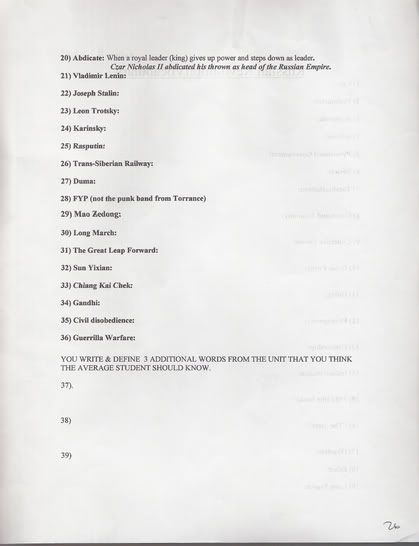
3) Vocabulary (1-19) (20-39) & here is some Vocab Jeopardy (Word Doc)
4) Revolution in Russia Worksheet & (Power Pt) (Word Doc)
5) Russian Revolution Video Notes
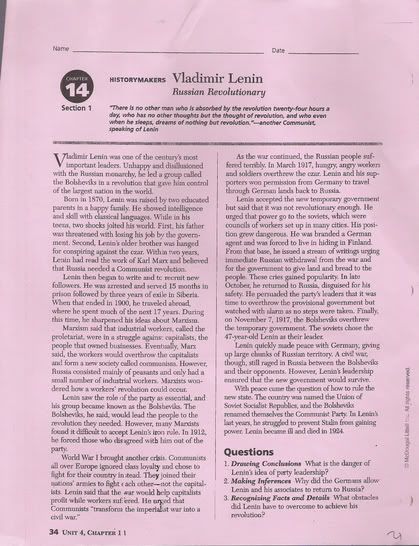
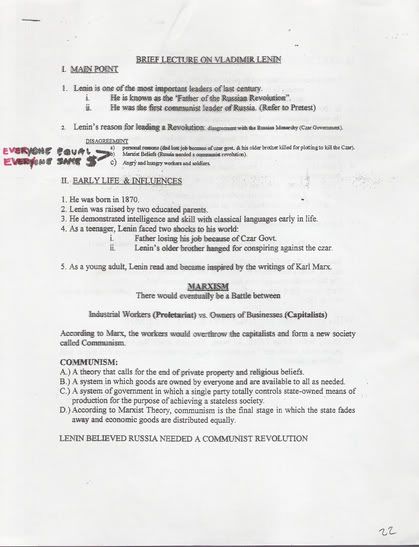
6) Vladimir Lenin (front) (back)
7) Stalin Video Notes
8) Patterns of Change: Stalin's Totalitarianism
8a)Totalitarian Notes
9) Chinese Revolution Timeline & Review (9A-9D) (What to study for Chinese Rev Exam?)
10) Mao Video Notes
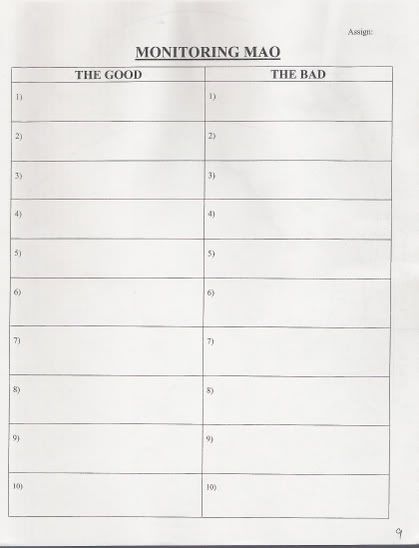
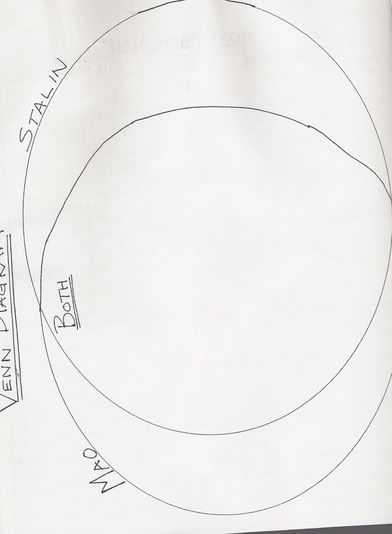
11) Monitoring Mao (front) / Venn Diagram (back)
12) India Packet
13) Algeria Questions
14) Battle for Algiers vs Gandhi


The following weekly agenda is a guide to what is intended to take place in class this week. However, due to many circumstances, the agenda can get changed. Usually, the agenda is pushed back a day. Thus, what is due on Friday might be pushed back to Monday. Thank you and I hope you appreciate this weekly guide.


MONDAY March 14, 2011


1) P-Announcements - Reminder: P pts are 4% of Total Semester Grade
2) Comments, Class Grades & Discussion for Semester thus far
3) Forecasting Chinese Revolution (Periods predict what will happen)
4) Start Chinese Revolution (CR) Packet - CR Timeline

HW:

A) Study Chinese Revolution Timeline & Review
B) (What to study for Chinese Rev Exam?) (THURSDAY)
C) Vocab Prep with some Vocab Jeopardy / List of Words for Vocab Game (FRIDAY)


TUESDAY March 15, 2011

1) Chinese Revolution Timeline Review / Quiz?
2) Chinese Revolution Student Video Notes

HW:

A) Write out CR Vocab words and definitions
B) Study Chinese Revolution Timeline & Review
C) (What to study for Chinese Rev Exam?) (THURSDAY)
D) Vocab Prep with some Vocab Jeopardy / List of Words for Vocab Game (FRIDAY)


WEDNESDAY March 16, 2011


1) Mao Video Notes
2) Monitoring Mao (front) / Venn Diagram (back)
3) Comparing Mao & Stalin / Russian Revolution & Chinese Revolution

HW:

A) Complete Chinese Revolution Packet (Due Tomorrow)
B) Study Chinese Revolution Timeline & Review
C) (What to study for Chinese Rev Exam?) (TOMORROW)

THURSDAY March 17, 2011 (Happy St Patrick's Day)


1) Chinese Revolution Packet (Due before tardy bell)
2) Chinese Revolution Exam
3) Vocab Prep with some Vocab Jeopardy / List of Words for Vocab Game

HW:

A) Study for Vocab Game
B) Vocab Prep with some Vocab Jeopardy / List of Words for Vocab Game (FRIDAY)


FRIDAY March 18, 2011


1) Vocab Game (Russian Revolution & Chinese Revolution)

HW:

None


LEGACY PROJECT INFORMATION


A) Legacy Project approval deadline was St Patrick's Day (March 17th, 2011). The approval deadline has been extended to April 2nd (Day before Mr P's Mom's Birthday). Do NOT wait until the last moment to get approved. Mr P will be occupied with getting his mother a birthday present. If you are NOT approved or have NOT approached Mr P with proposals in advance of the deadline, you will NOT be doing a legacy project but taking the semester final exam.

B) Semester Final is either the Final Exam or a Legacy Project. All students wishing to do a Legacy Project must get approval from Mr. P prior to April 2nd, 2011).

C) All students not doing a Legacy Project will take a semester Final Exam. The Final Exam is multiple choice. Questions for the multiple choice exam will be cumulative. Thus, any content covered during the first semester can appear on the Semester Final Exam.

D) The Semester Final will be at the end of semester. Students taking the Final Exam will take it at the end of the school year. Students doing a legacy project will turn it in the day the students (not doing a legacy project) take the Semester Final Exam.

LEGACY PROJECT FORMS

1) Blank Proposal Application & Sample of filled out Application
2) Contract
3) Update Form & Calendar
4) Legacy Project Ideas - if you can't come up with ideas of your own
5) Sample WWI Vocab - Gives ideas on how to do Legacy Vocab.
6) Sample - WWI Play - Gives ideas on how to do Legacy Play.

SEMESTER FINAL

LEGACY PROJECT OR FINAL EXAM

Each semester students will have a choice of taking either the Final Exam or doing a Legacy Project as their ‘semester’ final. The semester final (exam or project) will equate to 20% - 25 % of the student’s semester grade. There is an application and qualification process that involves doing a legacy project. All students who do not apply or qualify to do a Legacy Project will partake in Final Exam process as a means of fulfilling their semester final obligation for the course. Written below are the specifics for both the Legacy Project and Final Exam.

LEGACY PROJECT

There are several purposes for students to apply to do a legacy project.

1) Students want to create a project to assist & inspire future students’ learning.
2) Students actually want to make a difference and contribute to the betterment of Mr. P’s class.
3) Students prefer to create a project versus taking an Exam for a final.


All student interested in doing a Legacy Project for their semester final must apply and qualify to do a legacy project. To apply and qualify for the Legacy Project, students must submit at least 3 typed proposals to Mr. P. In addition, students are required to schedule a brief meeting with Mr P after school to explain their legacy project proposals. Basically, students are to ‘sell’ their legacy project idea to Mr. P. Students will “qualify” to do a legacy project, if students convince Mr. P of the usefulness of their Legacy Proposal(s). Students should bring their 3 typed legacy proposals and explain them to Mr. P. At the after school meeting, students MUST do the following:

A) Be prepared, articulate and brief (Mr. P is a busy guy and doesn’t like to waste time)
B) Quickly & clearly explain to Mr. P your Legacy ideas (Mr. P has to be able to understand what it is)
C) Explain how it will be beneficial to future students, Mr. P, etc.
D) A typed working schedule that explains how you will be completing the project
E) Samples that demonstrate your ability to do certain kinds of work (i.e. your artwork, video equipment, computer skills or previous projects your done).


The deadline to apply and qualify for doing a Legacy Project as a student’s “Final” for the Fall semester will be October 31st (Halloween) and for the Spring semester March 21st (Equinox). If a student does not apply and qualify by this date, the student will then, by way of default, partake in the Final Exam process at the end of the semester. If a student qualifies and agrees to do a Legacy Project, then he/she is committed to doing a Legacy Project. They will not be allowed to change from doing a Legacy Project to taking the “Final Exam.”

GROUP or SOLO WORK: Mr. P highly recommends that students work solo on their legacy project. Once again, he advises students do NOT work with other students. However, students might be allowed to work with others if they can justify the need to have more than one person do the project. Yet, the group work limit is 3 students. Students may also work with students in Mr. P’s other World History classes. Most importantly, if students qualify to work in a group it is entirely their choice and responsibility to do so. Mr. P will NOT, once again, will NOT hear any grievances or feel any sympathy pertaining to group work problems. Group work is a choice of the students. Again, Mr. P suggests students do NOT work in groups. Yet, students are old enough to make their own decision on such matter.

LEGACY GRADING SYSTEM:

A Grade:

Most likely any legacy project that will be or is actually used in Mr. P’s class achieves an “A” grade. If Mr. P will not use it in the future, it probably is NOT going to get an “A” grade. Legacy projects rarely take 1 day or 1 weekend to complete. Students with a desire to achieve an “A” should put in a fair amount of time and effort to complete their legacy project. However, time and effort does NOT necessarily equate to an “A” grade. Students can work very hard and still not achieve an “A” grade. The project should be of the utmost quality. It should also be ready for classroom use. Usually any needed adjustments that Mr. P has to do will deduct from the grade of the Legacy Project. All students witness how Mr. P runs the class on a daily basis. Students should become aware of what is “needed” and what “works” with regards to legacy projects. Also, “A” legacy projects are well labeled, packaged, easily stored or accessed. Presentation of the Legacy Project is memorable. It is NOT just another boring final presentation. Fellow students believe the project is useful and of quality.

B Grade:

Usually a good legacy project but does not do all the requirements listed for an “A” grade. Most likely, a “B” grade results because Mr. P will have to “adjust” the project so that it can be used in class. “B” rate Legacy Projects lack the originality, usefulness and quality in comparison to “A” rate Legacy Projects. Presentation of the project is above average and is somewhat memorable.

C Grade:

Results when the Legacy Project will NOT be used in the classroom. It does NOT fulfill the general standards of a “B” grade. Presentation of the project is average and is NOT memorable.

D Grade:

“D” stands for Disappointment. This project is obviously substandard to what is expected of Legacy Projects. It appears to be done quickly and with substandard care. It will NOT be used in the classroom. Presentation is unprepared, robotic and/or boring.


F Grade
:

Produces an overall gross Legacy Project. There is a sense of making a mockery out of doing the Legacy Project. Unorganized and poor presentation. If anything, this project serves as a sample of what NOT to do for a Legacy Project.


FINAL EXAM

The Final Exam will take place the day of the scheduled final in late January for the fall semester and in June for the spring semester. The Final Exam will consist of approximately 100 multiple choice questions. The questions will be related to the unit topics covered during the semester. Students are welcome to pick the Final Exam as their semester final.

180 – 200 correct; 90% - 100% = A
160 – 179 correct; 80% - 89% = B
140 – 159 correct; 70% - 79% = C
120 – 139 correct; 60% - 69% = D
0 – 119 correct; 0 - 59% = F


_____________________________________________________________________________________________________________________


2nd SEMESTER GEOGRAPHY MINI-UNIT


Get studying your geography! Geo Retake Exams are usually offered Wednesdays after school at 3:22pm. There has already been 5 Retakes and a few students have already "aced" the Retake and had their original score changed to a Perfect 30/30. Be sure to take advantage of this "extra" offer to improve your grade.

Below are a variety of Geo Related Power Points and Worksheets to prepare you for the Geo Exam. More information about the Geography Exam and Geo Unit will be given in class.

1) ULTIMATE GEO POWERPOINT - This pretty much has it all. This is used in class, great practice exams & lots of info. This big file will take a few minutes to download.

2) Colorful Map Packet Study Guide
- These are scanned map packets done by legendary students Grace Cho, EriKa Roos and Connie Chen. Be happy here folks! You do NOT have to spend the time coloring in and identifying locations on a blank map packet thanks to these girls. So use that time to study study study! You can use this power point to study geography locations and statistics. Mr P highly recommends using this to study for the Geo Exam. If you cannot download it, then bring a USB to class and copy off the student computer. Or have a friend download and send it to you via email. Good luck!

3) Do you need help studying? Go to Legendary Sketch's Geo Page! Over the years, students mention this website as being a huge help. Check it out. (She's a super student from the past that was awesome enough to leave behind this website for you. Ask Mr. P about her!)

4) Don't have Powerpoint? Only want to get a hold of one page? (...or 2... or 3.... or....)
- Pg 1 (Locations pg 1)
- Pg 2 (Locations pg 2)
- Pg 3 (World map)
- Pg 4 (Africa map)
- Pg 5 (Asia map)
- Pg 6 (Europe map)
- Pg 7 (N. America map)
- Pg 8 (S. America map)
- Pg 9 (Australia map)
- Pg 10 (Middle East Locations pg 3)
- Pg 11 (Middle East / Central Asia map)
- Pg 12 (Israel / Palestine map)
- Pg 13 (1 Page Geo Stat Sheet) - 2nd semester includes questions on Geo Stats such as population, world religions, etc.

_________________________________________________________________________________________________________


20th CENTURY REVOLUTIONS

1) Table of Contents (TOC)
2) Pretest
3) Vocabulary (1-19) (20-39) & here is some Vocab Jeopardy
4) Revolution in Russia Worksheet & (Power Pt)
5) Russian Revolution Video Notes
6) Vladimir Lenin (front) (back)
7) Stalin Video Notes
8) Patterns of Change: Stalin's Totalitarianism
8a)Totalitarian Notes
9) Chinese Revolution Timeline & Review (9A-9D) (What to study for Chinese Rev Exam?)
10) Mao Video Notes (***See below if you were absent)
11) Monitoring Mao (front) / Venn Diagram (back)

*** Absent students can make up the Mao Video Notes***

Research and type a 1 page (front side & single space) essay on the following:

1) Do 15 year olds today need to know about Mao ZeDong? Why or why not?
(Do NOT write an essay about the basic facts of Mao (birth, how long he ruled, etc). Instead, answer the essay question: Do 15 years olds need to know about this guy? and include facts about Mao that helps you answer the Essay Question)

or

2) Was Mao and Stalin more similar or difference from one another? Explain.